Home/Training/Polygraph Examiners
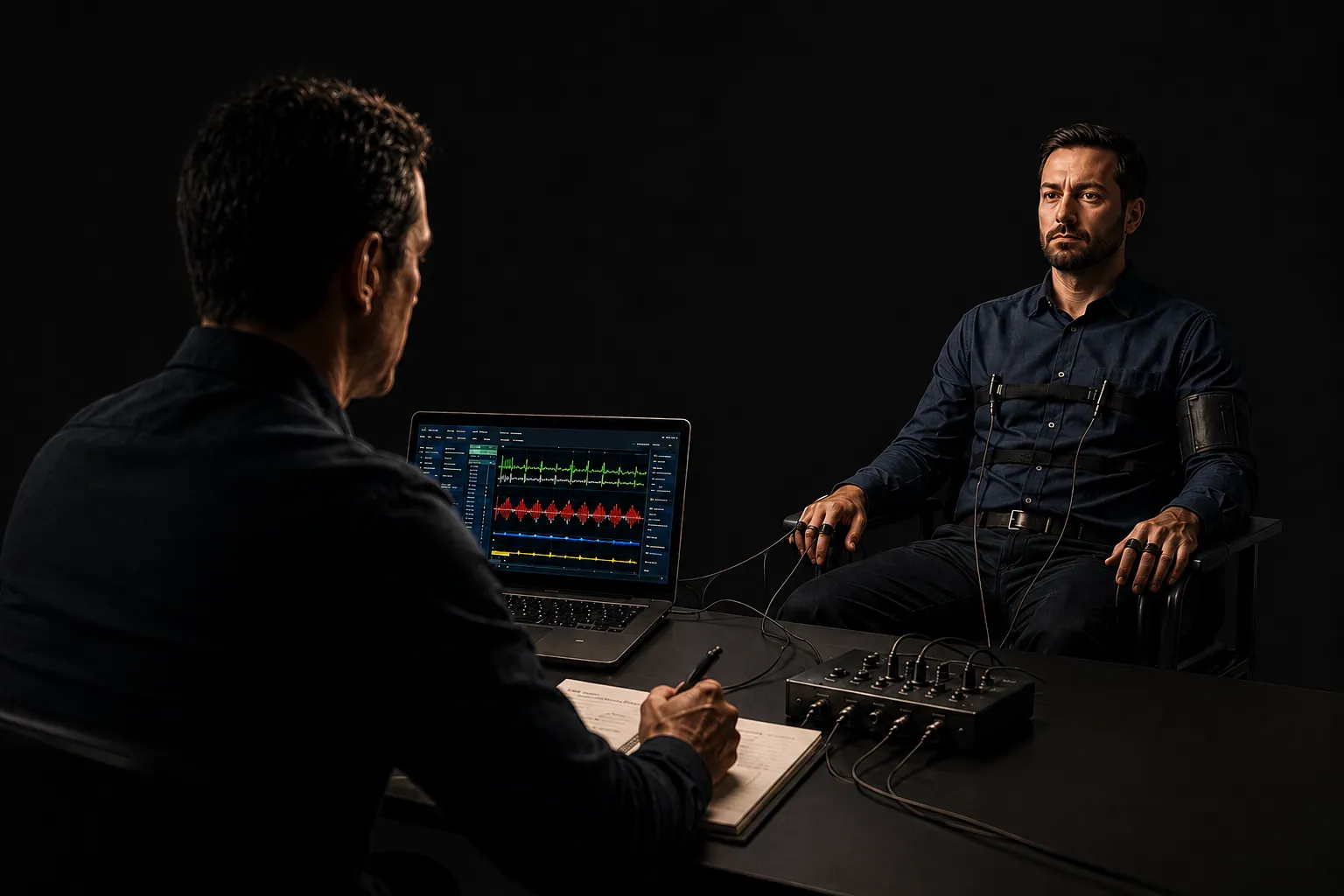
Polygraph examiner conducting an exam, charts visible on the laptop, subject seated with sensor cuffs
Polygraph Examiners
Advanced interview training for certified examiners

The interview is the difference.

The polygraph-examination deployment of the Teach to Talk® methodology and the Adaptive Strategies Compass™. Built for the pre-test and post-test interviews that determine the value of the examination.

The most valuable part of a polygraph examination is not the instrument. It is the interview. Built for examiners who want to strengthen the most important component of the examination process: human communication.

This is an additive course for already-certified examiners. Not a polygraph certification path.

Rapport·Behavior·Strategy·Disclosure

Built by a former polygraph examiner and Regional Coordinator.

Pre-test Rapport·Behavioral Observation·Adaptive Communication·Strategic Interviewing·Teach to Talk®

Sector
Law Enforcement
Duration
2 to 3 Days
Level
Certified Examiners
Format
Agency On-Site
Request This Training
The Core Principle
The Interview is the Difference

The most valuable part of a polygraph examination is not the instrument.

Physiological data is investigative insight. The quality of the information obtained before, during, and after the examination is driven by the examiner’s ability to build rapport, establish credibility, recognize behavioral changes, manage resistance, and conduct purposeful investigative interviews.

Research and real-world investigative experience consistently demonstrate that meaningful disclosures, clarifications, admissions, and case-critical information are most often developed through skilled interviewing, not through confrontation, scripts, or overreliance on instrumentation alone.

This course focuses on the strategic communication skills that separate technically competent examiners from truly effective investigative interviewers.

What Examiners Will Learn

Nine capabilities the course is built to develop

Capability One

Authentic Rapport

Build real connection with the examinee while maintaining professionalism and the control the examination requires.

Capability Two

Stronger Pre-test Interviews

Conduct pre-test conversations that improve cooperation, engagement, and information quality before a single chart is run.

Capability Three

Read Behavioral Change

Recognize the deviations that indicate stress, emotional significance, cognitive load, avoidance, or increasing trust.

Capability Four

Adapt In Real Time

Shift communication style based on the examinee’s personality, demeanor, and behavioral presentation as the interview unfolds.

Capability Five

Reduce Resistance

Lower defensiveness and reactance without sacrificing investigative effectiveness or the integrity of the examination.

Capability Six

Post-test Interview Strategy

Post-test conversations designed to encourage clarification, disclosure, and truthful conversation. Not confession-at-any-cost.

Capability Seven

Avoid Communication Mistakes

Recognize the common, often unintentional missteps that increase resistance or contaminate the information being gathered.

Capability Eight

Credibility & Command Presence

Strengthen examiner confidence, presence, and credibility, the qualities the room reads before any question is asked.

Capability Nine

Integrated Practice

Weave behavioral observation and strategic interviewing into every phase of the examination from greeting to closeout.

The Evidence-Based Position

Deception is identified through inconsistencies, not body language.

ASC Position

Unlike outdated approaches that rely on intimidation, accusation, or simplistic interpretations of body language, this program emphasizes a modern, research-supported approach to investigative interviewing.

Participants learn that deception is most reliably identified through inconsistencies in facts, statements, evidence, and behavioral context, not through isolated gestures or “tells.”

Nonverbal behavior matters because deviations from a person’s baseline can indicate stress, cognitive load, emotional significance, discomfort, avoidance, or developing trust. The behavioral shift is information. Whether it indicates deception is a question answered by the facts and the evidence, not by the shift itself.

Special Emphasis

Eight focal areas woven through the course

Psychology of Rapport

How cooperation forms, why it accelerates disclosure, and how to engineer it on purpose.

Examiner Behavior

How the examiner’s tone, pacing, and presence shape what the examinee feels safe to share.

Behavioral Baseline

Establishing the neutral signature early so meaningful deviations actually register later.

Communication Under Stress

How to stay regulated, intentional, and calibrated when the room is at its hardest.

Investigative Listening

Active, signal-aware listening that catches what the words do not carry alone.

Strategic Question Formulation

Question design that elicits information without contaminating it.

Trust Development

Building credibility and connection in high-stakes interactions where the clock is short.

Psychological Safety

The relationship between safety, disclosure, and the quality of every answer that follows.

The Compass, Calibrated for the Examination Process

Eight strategic directions. Built into pre-test, examination, and post-test.

The instrument records data. The interview produces information. The Adaptive Strategies Compass™ gives the examiner a complete operating system for the conversation around the chart, calibrated for the unique pressures of pre-test rapport, in-examination consistency, and post-test disclosure.

1Direction One

Teach to Talk®

Strategic, non-confrontational dialogue applied across every phase of the examination. The conversational discipline that makes voluntary disclosure the natural outcome of the post-test interview.

2Direction Two

ACCESS Model

A six-stage investigative thinking framework (Assess, Collect, Collate, Evaluate, Survey, Summarize) applied to the full arc of the examination from initial referral through final disposition.

3Direction Three

Personality Assessment (DISC)

Behavioral style reading in the pre-test interview. Knowing how the examinee processes pressure before the first chart is run is the single highest-leverage adjustment an examiner can make.

4Direction Four

Cognitive Interview

The most research-validated technique for improving recall accuracy, applied to pre-test memory elicitation and post-test clarification. Context reinstatement and varied retrieval that surface information the standard pre-test interview routinely misses.

5Direction Five

Route Map

Pre-examination planning that anticipates where the examinee is likely to resist, where the post-test conversation will branch, and how the examiner navigates from chart result to truthful account.

6Direction Six

Motive Mapping

Five lenses (Rationalize, Project, Minimize, Socialize, Emphasize the Truth) for understanding why an examinee is behaving the way they are at each phase of the examination process.

7Direction Seven

Strategic Use of Evidence (SUE)

The disciplined disclosure of physiological findings during the post-test interview. Timing and sequencing of chart-based evidence to encourage truthful clarification rather than reactive denial.

8Direction Eight

Alignment Method

Challenge-and-clarify questioning that resolves the discrepancy between physiological data and verbal account. The technique that turns an inconclusive examination into an admissible statement.

Every direction of this Compass deploys somewhere in the examination process. Examiners leave this course with the complete framework, calibrated for the pre-test, examination, and post-test work that determines whether the examination becomes evidence.

Explore the Adaptive Strategies Compass™ →
Who Should Attend

Designed for the examiners and investigators around the examination

Law Enforcement Polygraph Examiners

Federal Examiners

Public Safety Examiners

Administrative & Internal Affairs Examiners

Background & Screening Examiners

Investigators Conducting Post-Polygraph Interviews

Professionals Improving Examiner Communication & Interviewing Effectiveness

Joseph R. Auriemma, Jr.
32
Examiners Overseen
24 Yrs
NYSP Experience
The Instructor

A Certified Polygraph Examiner who supervised 32 examiners across a region

Joseph R. Auriemma, Jr. is a Certified Polygraph Examiner who served as a Regional Coordinator overseeing 32 examiners during his 24 years with the New York State Police, including 6.5 years in the Major Crimes Unit. He retired as a Senior Investigator supervising 5 investigators and 29 uniformed troopers, with thousands of interviews across the full investigative spectrum.

Through FBI-facilitated coordination on a major homicide investigation, Joe engaged engineering personnel at Google about deleted-user-data records that existed in Google systems but were not being produced in response to lawful process. Those findings directly contributed to the development of what became known as the Google Tombstone Report, an internal Google record now relied on by law enforcement worldwide. That same investigative discipline is the foundation of every course he teaches, including this one.

Certifications: Certified Polygraph Examiner · IADLEST National Certified Instructor (INCI) · Certified Forensic Interviewer (CFI)

Closing Note

The instrument records data. The examiner interprets people.

The instrument does not produce the admission. The examiner does. The pre-test conversation that builds enough trust for disclosure, the in-examination presence that keeps the room calibrated, and the post-test interview that turns physiological findings into a voluntary truthful account, that is where the examination becomes evidence.

Contact ASC to bring this training to your polygraph unit and equip your examiners for the conversations that determine what every chart actually means.

FAQ

Common questions about this course

How long is the Polygraph Examiner Interview Training course?

The course is delivered in a two-to-three-day format on-site at your agency. The two-day version covers the complete pre-test and post-test interview curriculum; the three-day version adds extended scenario work and more individual coaching. Both are designed for examiners already certified in polygraph methodology.

Who should attend this polygraph interview training?

This course is built for certified polygraph examiners, law enforcement, federal, and credentialed private-sector examiners, who want to elevate the interview portions of the examination. It is not a polygraph certification course; it presumes existing examiner credentials and focuses on the pre-test and post-test interview skills that determine examination outcomes.

How does this course complement traditional polygraph training?

Traditional polygraph training focuses on instrumentation, question construction, and chart analysis. This course addresses the interview skill set that surrounds the chart, pre-test rapport and disclosure, post-test interviewing that extends beyond physiological data, and credibility assessment that integrates behavioral observation with examination results. The skills directly affect examination accuracy and admission rates.

What does the Polygraph Examiner course cover?

Structuring pre-test interviews for maximum voluntary disclosure, non-confrontational post-test interview strategies that extend beyond physiological data, credibility assessment frameworks that go beyond the polygraph result, reducing false positives through better pre-exam questioning, rapport-building strategies tailored to the examination context, and documentation practices that protect the integrity of the examination.

How does ASC’s approach differ from older, confrontational interrogation methods used in polygraph contexts?

Older confrontational, accusatory interrogation methods are widely associated with examiner confrontation that can compromise both the chart and the resulting statement. ASC teaches a non-confrontational, evidence-based alternative: strategic disclosure, rapport-based questioning, and Strategic Use of Evidence, that produces more reliable physiological data, fewer false positives, and statements that hold up under court challenge.

What credentials and experience does the instructor bring?

Joseph R. Auriemma, Jr. is a Certified Polygraph Examiner who served as a Regional Coordinator overseeing 32 examiners during his 24 years with the New York State Police, including 6.5 years in Major Crimes. He holds the IADLEST National Certified Instructor (INCI) and Certified Forensic Interviewer (CFI) credentials and has trained 6,500+ professionals.

Is this training non-confrontational?

Yes. The entire methodology is built on non-confrontational, evidence-based interviewing. The goal of the post-test interview is accurate, complete, court-defensible information, not a confession at any cost. Examiners trained in this framework report better disclosure rates, fewer false positives, and post-test statements that survive cross-examination and admissibility challenges.

How do I bring this training to my polygraph unit?

The course is delivered on-site at your agency or examiner association. Contact ASC through the Request Training form or by calling (914) 489-2330 to discuss scheduling, examiner count, and case-type emphasis. Joe responds personally and tailors the curriculum to the examination categories your unit handles most often.

Ready to bring this course to your team?

Request information or schedule a strategy call to discuss your organization's needs.