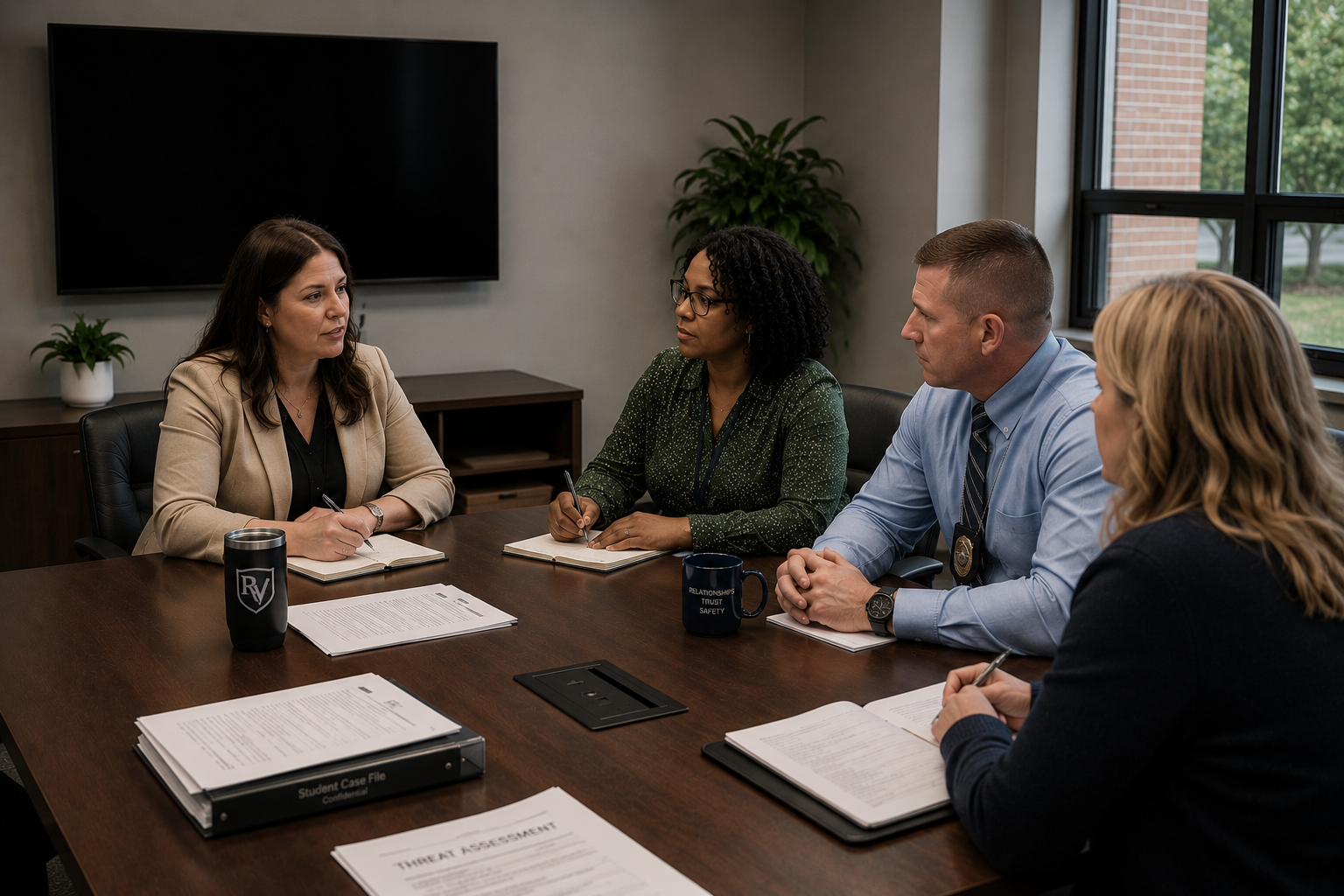
A threat assessment is only as good as the interviews it stands on.
The Threat Assessment Interview is the one-day course for the teams your framework training built. CSTAG, NTAC, and NABITA teach the model: the rubric, the classification, the case management. This course teaches the conversations that feed it: the student of concern, the classmates who reported it, the teachers, and the parents. The framework decides. The interviews inform. This is the interview course.
Lawful·Age-Appropriate·Uncontaminated·Defensible
The model is trained. The interview is not.
Every state mandate and every major framework (CSTAG, the Secret Service NTAC model, NABITA) gives threat assessment teams the same architecture: gather information, evaluate it against the rubric, classify, manage. The architecture is sound. The vulnerability is upstream of it: nearly all of the information the team evaluates comes from interviews conducted by people who have never been trained to interview.
The failure modes are predictable:
- A student-of-concern interview conducted like a disciplinary confrontation, producing shutdown, escalation, or a false read in either direction
- Leading questions that put words in a frightened student's mouth, and into the assessment record
- Peer witnesses interviewed after the story has circulated through a lunch period, so the team evaluates one rumor told four ways
- A parent interview that turns the team's best potential ally into an adversary in the first five minutes
- Age-inappropriate technique with younger students, and legally non-compliant technique with older ones
- Documentation that records conclusions instead of observations, and cannot survive an expulsion hearing, a criminal referral, or a civil suit
- No plan for the handoff: where the school's interview must stop and the SRO's or police interview must begin
The Secret Service National Threat Assessment Center's November 2025 report, The State of Behavioral Threat Assessment and Management in K-12 Public Schools, documented how inconsistent team training remains. The interview is the least-trained skill on every team, and it is the skill every assessment stands on.
Your framework training taught the model. This course teaches the conversations.
If your team is trained in CSTAG, the NTAC model, or NABITA's case-management approach, keep it. This course assumes it, and it does not touch your rubric, your classification levels, or your documentation forms. What it adds is the discipline your framework training compresses into a slide or two: how to actually conduct the interviews whose quality determines whether the rubric gets accurate information to evaluate. The two trainings are designed to stack. Your team arrives knowing what to assess. They leave knowing how to conduct the conversations the assessment depends on.
Your framework training covers
- →The assessment model and rubric
- →Classification and risk levels
- →Team roles and composition
- →Case management and monitoring
- →Documentation forms
This course covers
- →The student-of-concern interview
- →Peer and witness interviews without contamination
- →The parent interview
- →Age-appropriate and legally compliant technique
- →Records that survive hearings, referrals, and litigation
- →The law enforcement handoff
Together
A sound assessment model, fed by sound interviews. That combination is what a defensible threat assessment looks like.
What makes this course different
The only interview-craft course in the threat assessment market
Framework providers teach what to gather. No national vendor teaches school teams how to gather it. This course exists for exactly that gap.
Taught by a career investigator who has done these interviews
A 24-year New York State Police major-crimes investigator and crisis negotiator who interviewed minors for two years inside a Child Advocacy Center under forensic protocols, and taught interviewing at the New York State Police Academy.
Built for the legal terrain schools actually stand on
FERPA, juvenile interview law including the growing list of state deception restrictions, custody questions when an SRO is in the room, and the DASA and Title IX crossover points. The interview that helps the assessment must not ruin the prosecution, the hearing, or the district's legal position.
Assessment, not accusation, as a trained discipline
The same equal-rigor, non-accusatorial methodology behind every ASC course, calibrated for adolescents: diagnose the barrier (fear, shame, loyalty, distrust, reactance), remove it, and get the accurate account the rubric needs, without treating a scared student as a suspect.
It ends with practice, not a packet
The course closes with live practice interviews across all three conversation types (student of concern, peer witness, parent), coached one-on-one against a published rubric. Teams leave having done the interviews, not just heard about them.
Designed for every role on the threat assessment team.
Threat Assessment Team Members
Administrators, counselors, school psychologists, and safety personnel who conduct or sit in on team interviews. The core audience.
School Resource Officers
The sworn member of the team, whose presence changes the legal posture of every interview. The course addresses the SRO's dual role directly: when the school interview is theirs, when it is not, and how the handoff works.
K-12 Principals and Assistant Principals
Often the first interviewer by default, before the team ever convenes. The first conversation is frequently the most consequential and the least prepared.
Higher Education BIT and CARE Teams
The behavioral intervention calibration: adult students, FERPA, Title IX adjacency, and the same interview craft applied to the campus context.
One day. Eight modules. The interviews the assessment stands on.
Tuition, published
The team rate is twenty seats at the published per-attendee rate. Book the whole team, same price per seat, no games.
Every tuition includes the 8-hour course, attendee reference cards, live practice interviews with instructor coaching, the certificate listing contact hours, and 30 days of post-course email support.
District, BOCES, and cooperative deliveries: one delivery can train every team in a district or every member district in a cooperative. Purchase orders accepted; school-safety grant funding, including federal COPS School Violence Prevention Program awards, routinely covers team training of this kind, and ASC provides the documentation your grant file requires.
Common questions about The Threat Assessment Interview
Does this course replace CSTAG, NTAC model, or NABITA training?
No, and it is not designed to. Those trainings teach the assessment framework: the rubric, the classification, the case management. This course teaches the interviews that feed the framework. Teams should hold both. The course references your framework's information needs throughout and sends better inputs into whichever model your team uses.
Who should attend?
The people who conduct or participate in team interviews: administrators, counselors, school psychologists, SROs, deans, and district safety staff. The course is built for mixed teams and is most effective when a school's full team attends together.
Does it cover interviewing minors lawfully?
Yes. Age-appropriate technique, the growing list of state restrictions on deceptive tactics with juveniles, custody considerations when a sworn officer participates, and the point at which a school interview must stop and a law enforcement interview must begin.
Is this for K-12 only?
K-12 is the primary calibration. A higher-education calibration serves BIT and CARE teams, addressing adult students, FERPA, and Title IX adjacency with the same interview methodology.
How does this relate to ASC's Title IX program?
Same buyer, different room. From Complaint to Finding trains Title IX and DASA investigators; The Threat Assessment Interview trains the threat assessment team. Districts frequently book both in a single visit, and the two courses share the same underlying methodology, so teams trained in both speak the same language.
Can a district or BOCES host this for multiple schools?
Yes, and it is the most efficient way to buy it. One delivery trains every team in the district, or member districts across a cooperative. Contact ASC to scope a district or cooperative delivery.
What does The Threat Assessment Interview cost?
Published tuition is $345 per attendee for the one-day course, delivered open enrollment, closed to your district, or as a custom engagement. Closed and custom deliveries are quoted by proposal, and full pricing, including host comp seats and how travel is handled, is on the pricing page.
How do I bring this course to my district?
Contact ASC through the Request Training form or by calling (914) 489-2330 to discuss scheduling, team size, and calibration (K-12, higher education, or both).
What to expect, start to finish
The team is trained. Train the conversation.
The threat assessment teams that consistently make sound calls are not the ones with the best forms. They are the ones whose interviews put accurate, uncontaminated, complete information in front of the rubric, gathered lawfully, documented defensibly, and conducted in a way that leaves a frightened student, a reluctant classmate, and a defensive parent all still willing to talk to the school tomorrow.
Contact Advanced Strategic Communications to bring The Threat Assessment Interview to your district's teams.
Get the full syllabus and a sample agenda
Request the complete module-by-module syllabus and a sample day-by-day agenda for this course, sent to you personally by Joe. It is the document to forward to your command, training office, or budget approver, the thing that turns "this looks good" into an approved request.
Train the interviews your threat assessment stands on.
Request this training or schedule a strategy call to scope a school, district, or cooperative delivery.