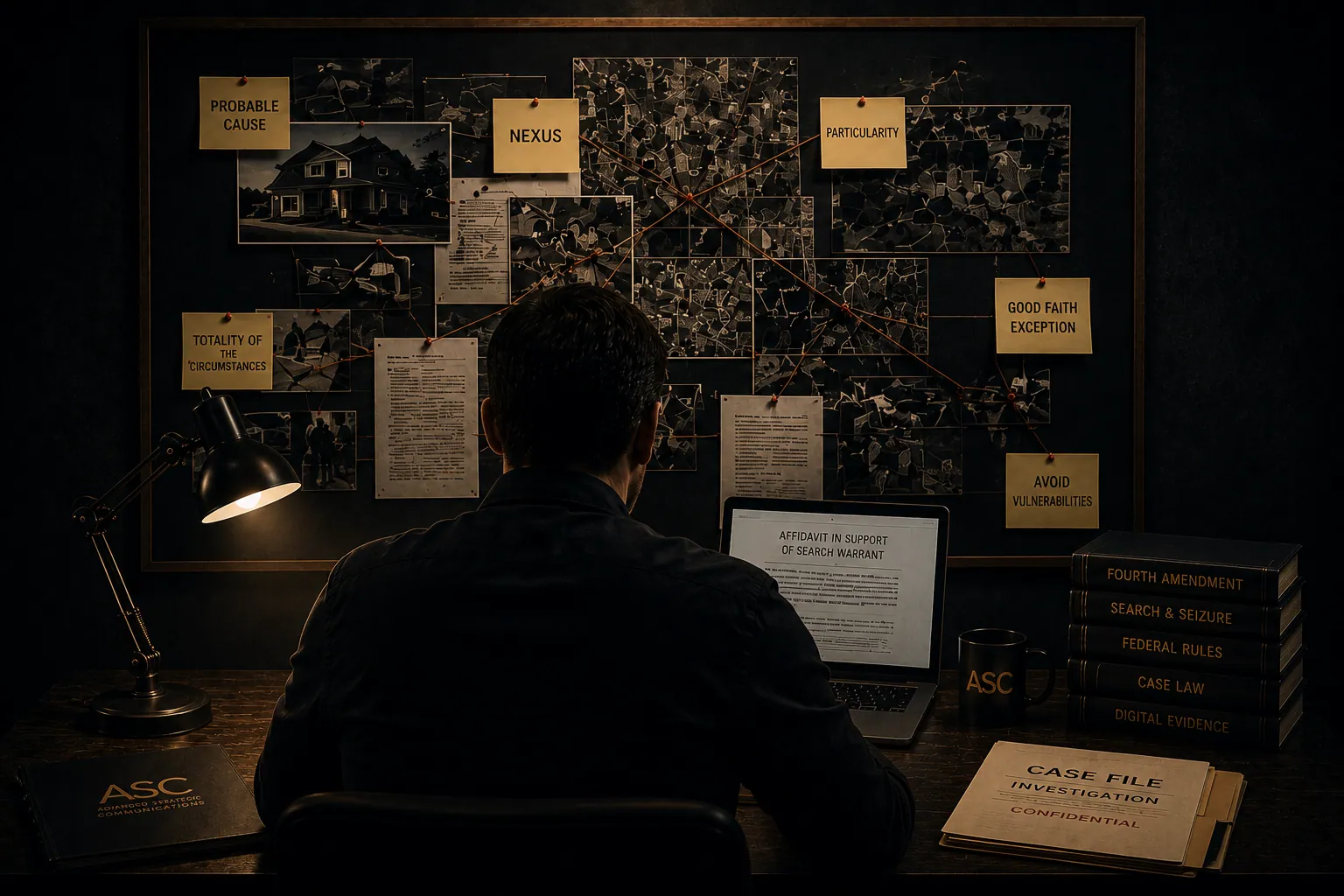
How long is the Precision Search Warrants course?
The course is offered in two-day and three-day formats. Both deliver the full curriculum and include The Affiant’s Standard. The three-day version adds extended drafting time, deeper case study work, and additional digital evidence coverage, the area of law evolving fastest and where affidavit errors are most costly.
Who should attend?
Patrol officers building independent warrant-writing capability, investigators and detectives across all crime categories (narcotics, homicide, digital evidence), supervisors who review warrant applications before submission, and prosecutors working with law enforcement on affidavit preparation. Understanding what makes an affidavit strong is inseparable from knowing what makes it vulnerable.
What’s the difference between the 2-day and 3-day formats?
The two-day format covers the full curriculum and is suitable for agencies with scheduling constraints or officers seeking focused warrant-writing fundamentals. The three-day format adds drafting time, extended case-study work, and deeper coverage of digital evidence applications (cell-site, geofence, social media platform orders, cloud storage).
Does the course cover digital evidence warrants (cell-site, geofence, social media)?
Yes, extensively. The Digital Evidence and Modern Investigative Warrants module covers cell-site location information, geofence warrants, social media platform orders, cloud storage, and third-party provider court orders, including frank current instruction on what data remains accessible and how to draft applications that return results, not rejections. Includes Carpenter v. United States and post-Carpenter doctrine.
Do attendees actually draft warrants during the course?
Yes. This is not a lecture series. Every officer drafts multiple complete affidavits from scenario packages drawn from real investigative case types, with structured review and direct instructor feedback. Each officer produces their own work, not group submissions. Attendees leave with real work product, not just a certificate.
What is the affiant biography and why does it matter?
Before a judge weighs your probable cause, they weigh you. The affiant biography is the professional narrative that establishes your credibility and survives cross-examination. Participants draft their own during the course, a document they refine and carry through their entire careers. Strong affiants get warrants signed; weak ones get them suppressed.
Is the curriculum tailored to my state’s case law?
Yes. Every course delivery is preceded by research to integrate state-specific statutes, appellate decisions, and procedural requirements throughout, not as an afterthought. The federal foundations (Katz, Gates, Kentucky v. King, Carpenter) are covered uniformly, but the controlling appellate and state-specific decisions are calibrated to your jurisdiction.
Does the course carry POST credit?
POST credit is variable by state. ASC files for POST or equivalent continuing-education credit where the hosting state allows it, and the filing is handled as part of the engagement. Because each state’s POST board sets its own rules, the exact credit is confirmed for your state when the delivery is scheduled.
How do I bring this course to my agency?
The course is delivered on-site at your agency in a two-day or three-day format and includes a copy of The Affiant’s Standard for each attendee. Contact ASC through the Request Training form or by calling (914) 489-2330 to discuss scheduling, format choice, and jurisdictional tailoring. Joe responds personally.
What does the Precision Search Warrants course cost?
Published rates for every ASC course, including Precision Search Warrants, are listed on the pricing page. Final pricing depends on format (two-day vs. three-day delivery), officer count, and scope of jurisdictional case law tailoring. Pricing includes a copy of The Affiant's Standard™ manual and the template library for every attendee. Joe responds personally and structures pricing based on the agency's case-type priorities.
How does the course stay current with evolving case law?
Search warrant case law evolves continuously, particularly in digital evidence and third-party provider doctrine. Every course delivery is preceded by current-law research integrating the most recent federal decisions and the controlling appellate and state-specific decisions for the agency's jurisdiction. The Affiant's Standard™ manual issued with the course is maintained as a living reference; agencies that have hosted the course can request updates on substantive doctrinal developments between deliveries. The curriculum is calibrated to current practice, not boilerplate fundamentals.