Home/About/Books/New York
Wood-paneled law library with leather-bound legal volumes, an open book on a walnut desk under brass lamplight
The Affiant’s Standard

New York Edition · Available Now

Built for New York. Written to survive.

The Affiant’s Standard: New York Edition is a two-volume system for the New York affiant. A 450-page manual walks CPL Article 690 and the full arc of drafting, execution, and suppression doctrine, section by section, alongside a 240-page Search & Seizure Companion covering the federal Fourth Amendment and New York’s Article I, Section 12 protections. Written from the affiant’s chair by Joseph R. Auriemma, Jr., across 24 years and more than 1,500 search warrants with the New York State Police. Not fill-in-the-blank templates, doctrine.

Not templates. Over 40 affidavit examples. Doctrine throughout.

CPL Article 690, section by section·Over 40 affidavit examples·Five New York case studies
Series
The Affiant’s Standard
First Volume
New York Edition
Format
Paperback
Author
Joseph R. Auriemma, Jr.
Order the Books
40+
Affidavit Examples
1,500+
Search Warrants Authored
7
Substantive Parts
$115
Volume 1 Price
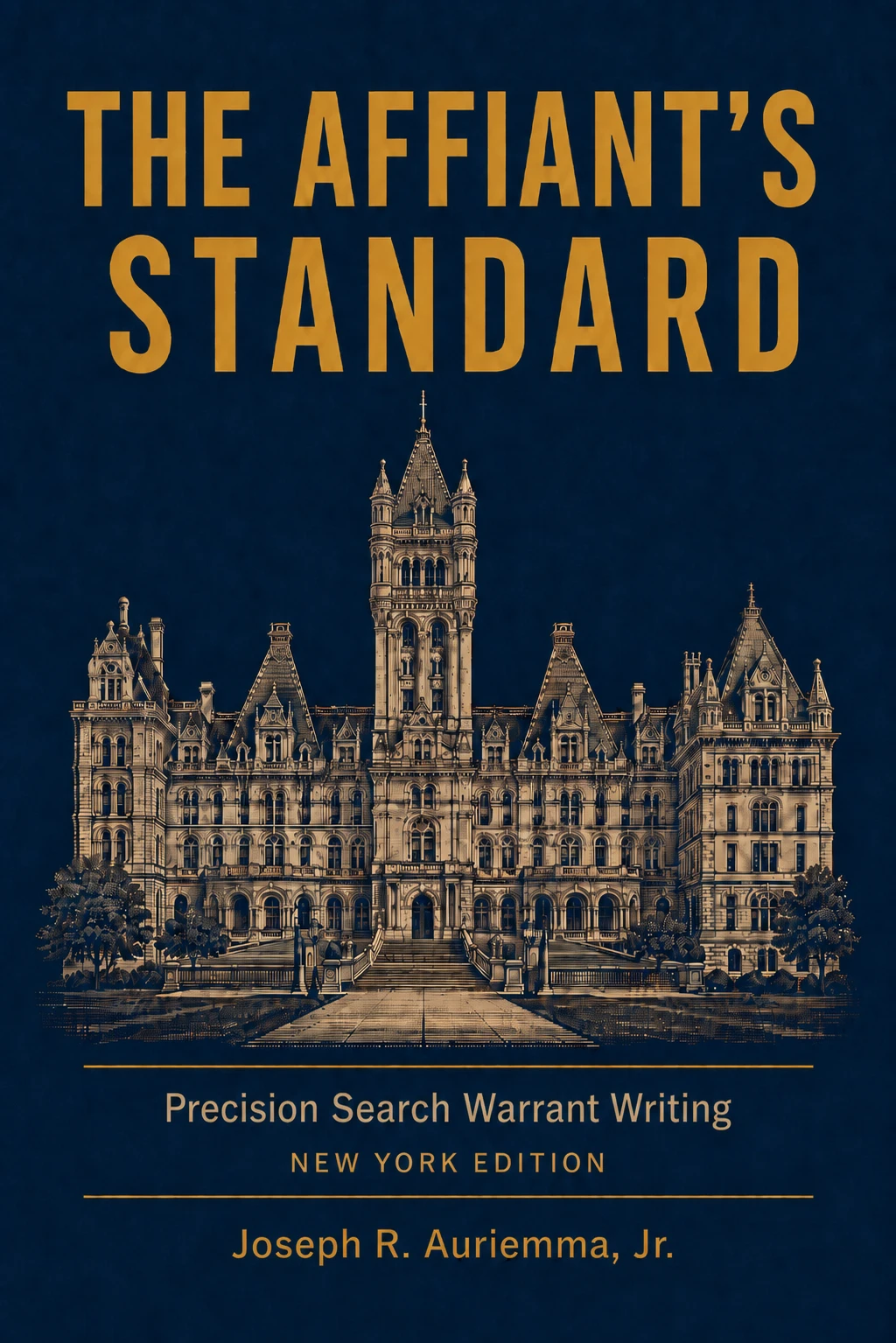
The Affiant’s Standard: New York Edition, by Joseph R. Auriemma, Jr.
$115
Paperback

Printed on demand. Allow 3 to 5 business
days for printing, plus shipping.

Volume 1 of the 50-State Series
New York Edition · Available Now

The Affiant’s Standard

By Joseph R. Auriemma, Jr. · Affiant on 1,500+ Search Warrants · 24 Years NYSP

A comprehensive, practice-driven guide for law enforcement professionals responsible for developing probable cause, drafting affidavits, and navigating judicial review. Written by a retired New York State Police Senior Investigator who served as the affiant on more than 1,500 search warrants, this manual goes beyond mechanics and templates to focus on disciplined thinking, precise articulation, and risk management for suppression.

It is grounded in real investigations, real judicial scrutiny, and real suppression litigation, not theory. This manual is designed to help investigators understand how courts actually read affidavits, why suppression occurs predictably, and how clear, fact-driven articulation protects strong cases.

Stand-Alone Reference

A practical field reference for any investigator who drafts warrants, from first warrant to your thousandth.

Course Companion

Designed to complement ASC’s Precision Search Warrants training, reinforcing and extending what’s taught in the classroom.

“Rather than providing fill-in-the-blank templates, the manual teaches a structured framework for thinking, writing, and self-auditing warrant applications so they withstand judicial and appellate review.”

View Search Warrant Course
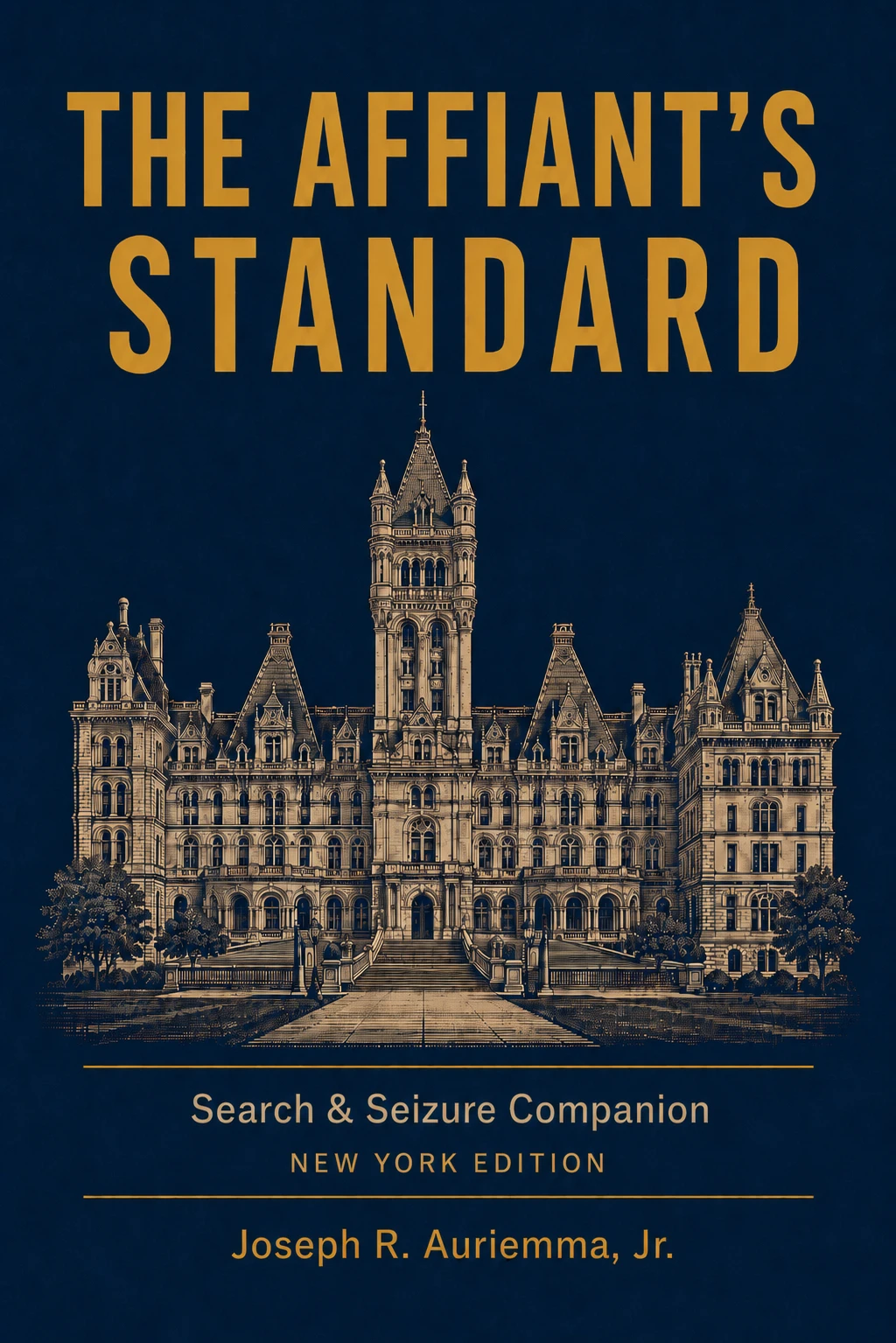
The Affiant’s Standard: New York Search & Seizure Companion, by Joseph R. Auriemma, Jr.
$59
Paperback

Printed on demand. Allow 3 to 5 business
days for printing, plus shipping.

Companion Volume to the 50-State Series
New York Edition · Available Now

The Affiant’s Standard: New York Search & Seizure Companion

By Joseph R. Auriemma, Jr. · The Constitutional Foundations Volume

The manual’s companion volume covers the constitutional foundations in depth: the complete federal Fourth Amendment framework (Katz, Gates, Carpenter, Riley, Jones, and every controlling precedent) in Part 1, and New York’s Article I, Section 12 protections in Part 2, including the De Bour framework, Aguilar-Spinelli, the MRTA’s effect on probable cause and canine sniffs, vehicle searches, consent, inventories, open fields, abandoned property, and multi-unit structures.

Both books use the same five-marker system, so the divergences between federal and New York law are flagged identically across the set. Together they form a complete search warrant training system for New York law enforcement.

View Search Warrant Course
The Complete Set

The manual and the Companion, together

Order The Affiant’s Standard and the New York Search & Seizure Companion at the same time and get the complete drafting-and-constitutional system in one purchase.

$149 for both books · $174 bought separately Save $25

Printed on demand. Allow 3 to 5 business days for printing, plus shipping.

The Series

The series. Volume by volume.

Search warrant doctrine is state-specific. Federal Fourth Amendment law sets the floor, but each state’s statutes, case law, and judicial culture shape how affidavits actually get read and ruled on. The Affiant’s Standard is built that way too: a separate volume for each jurisdiction, each one written from the inside, each one teaching the same disciplined framework calibrated for local practice.

Volume 1 · Available Now

New York Edition

Shipping Now

The flagship volume, written from the affiant’s chair across 24 years of New York State Police investigative work.

Next Volumes · In Development

Additional State Editions

Release TBD

Additional state editions in active development. State sequence will be announced as each volume enters production.

Long-Term Vision

Full 50-State Library

Multi-year publishing arc

The complete reference library spanning all 50 states, with each volume tailored to its jurisdiction’s statutes, case law, and judicial practice.

Inside Volume 1

Inside Volume 1. Seven parts. One discipline.

Volume 1 is structured around seven substantive parts, framed by a preface that establishes professional responsibility for the affiant and closed by a working reference apparatus: a glossary, a table of cases, a table of statutes and rules, and a full topical index. It is the drafting and execution volume, covering the full text and operation of CPL Article 690, probable cause development, affidavit drafting from statutory introduction to nexus paragraph, suppression doctrine with five New York case studies, warrant execution standards, specialized topics in digital and emerging evidence practice, and seventeen advanced decision-making outlines. It pairs with The Affiant’s Standard: New York Search & Seizure Companion, which covers the federal and New York constitutional foundations in depth.

Volume 1 contains over 40 affidavit examples, plus warrants, item lists, operations plans, returns, and defense motions, distributed across the manual. Each example is calibrated to a specific case type and doctrinal moment, with a Practitioner Note explaining why the example is constructed the way it is. The accordion below surfaces the example count under each Part so you can see at a glance which Parts carry the densest practical drafting content.

  • The core principle and what probable cause actually requires
  • Where affiants go wrong, and why digital evidence does not lower the bar
  • Warrant writing philosophy: judges are not adversaries, credibility is cumulative, articulation is evidence, restraint is persuasive, candor protects more than cleverness
  • How to use the manual, and what the manual does not do
  • CPL 10.10 court structure and jurisdiction, and why it matters for warrant applications
  • CPL 690.05 through 690.25: what a warrant authorizes, property subject to seizure, what and who is searchable, where executable, by whom executable
  • CPL 690.30 through 690.36: when executable, the 10-day rule, daytime versus anytime, the application requirements, and oral applications
  • CPL 690.40 through 690.55: determination of the application, in camera hearings, form and content of the warrant, execution, knock-and-announce, receipt, return, and disposition of seized property
  • Personal observation, training and experience used properly, victims and eyewitnesses, citizen informants
  • Confidential informants under Aguilar-Spinelli, anonymous informants and the corroboration requirement, Darden hearings, penal interest
  • Fellow law enforcement officers, accomplices and co-conspirators, admissions, physical and forensic evidence, electronic and digital evidence, hearsay, incorporation by reference
  • Manner of acquisition of proof, the four-factor staleness framework, nexus requirements for residences, vehicles, and digital devices
  • Particularity, overbreadth and severability, multi-unit structure description, anticipatory warrants, and controlled buy documentation
  • The statutory introduction, affiant background and qualifications, identifying the crime
  • Premises description standards, multi-unit structure drafting, and the limited purpose paragraph
  • The factual narrative: source attribution, separating facts from inferences, chronology and dating, addressing gaps, writing for the judge, neutral tone
  • The evidence sought item list with category-specific guidance for controlled substances, currency, digital devices, and documents
  • The dedicated nexus paragraph, including heightened digital nexus standards under New York law
  • Secondary requests: nighttime execution, no-knock authority, biometric device unlocking
  • Common affidavit defects that lead to suppression, and prosecutor collaboration
  • The seven suppression patterns: missing or attenuated nexus, digital evidence boilerplate, staleness without explanation, informant conclusions without facts, scope overreach, particularity failures in premises description, candor and completeness failures
  • Standing to suppress: Rakas v. Illinois and New York’s automatic standing rule
  • Five New York case studies on digital nexus failure, scope and particularity, case-specific digital nexus, staleness analysis, and informant reliability under both Aguilar-Spinelli prongs
  • Franks hearings under federal and New York standards, and Darden hearings as New York’s informant truthfulness mechanism
  • The affirmative case for getting a warrant rather than relying on an exception, and how to read your own affidavit as a defense attorney would
  • The warrant as scope-limiter, who may execute, and when scope begins
  • Knock-and-announce, the reasonable waiting period, and scene-based exigency
  • Nighttime/anytime execution under CPL 690.30(2), and the 10-day execution limit with reissuance considerations
  • The no-knock standard, the case-specificity requirement, and reassessment at the scene
  • Securing the scene under the McArthur rule, closed containers (and the third-party container problem), plain view during execution and the Hicks problem
  • Detaining and searching persons present, amending versus applying for a new warrant, and the bootstrapping prohibition
  • Post-execution: return, inventory, receipt for seized property, and discovery obligations under article 245
  • Cell phones under Riley, cell site location information under Carpenter, and biometric device unlocking with the Fifth Amendment testimonial-versus-physical distinction
  • GPS trackers and New York’s critical divergence from federal law, searching parolees and probationers (and the pretext problem), drones in investigations
  • Geofence warrants in the post-2024 Google Sensorvault landscape, and what data Google may still hold
  • DNA evidence and the Abe A. court order process under CPL 245.40(1)(e), abandoned DNA as a distinct legal category, CODIS, and protective orders
  • Subpoenas versus search warrants, pen registers and trap-and-trace devices under article 705
  • Emerging areas: reverse-keyword search warrants, end-to-end encrypted platforms, and pole cameras and long-term visual surveillance
  • Affiant credibility and risk management, suppression pattern recognition, probable cause narrative construction
  • The complete affidavit requirements outline under CPL Article 690
  • Articulation outlines for citizen informants, confidential informants under full Aguilar-Spinelli, anonymous informants, controlled buys, and consent searches
  • Nexus development and location justification across all evidence categories
  • Announced entry versus no-knock, detaining and searching people during execution, digital evidence preservation and pre-warrant handling
  • Judicial interaction and revision strategy, warrant amendment versus new warrant decision-making
  • The affiant across time: managing the long-term judicial relationship
  • Red-flag phrases and their disciplined replacements
  • Federal search warrant practice as a comparative framework, including Rule 41, the DOJ two-step protocol, privileged material handling, and task force drafting
  • Digital search protocols with affidavit examples for smartphones, computers, and cloud accounts and online services
  • A federal versus New York divergence reference covering more than twenty doctrinal areas, including good faith, informant standard, automobile exception, plain feel, vehicle inventory, open fields, abandoned property, GPS tracking, digital nexus, automatic standing, drones, and knock-and-announce
  • A sample warrant return and inventory form, and a tour of the common defense motions an affiant will face: standard suppression, Franks, Darden, Mapp, and Dunaway
  • How courts read affidavits (the judicial mental model), the common judicial questions during warrant review, and a pre-submission judicial self-audit checklist
  • Topical references for Franks risk and candor, scope control, paragraph construction, staleness, and case law by offense type
The Next Volumes

Be the first to know when your state ships.

The New York Edition and its Search & Seizure Companion are available now. Additional state editions are in active development. Join the list to hear which state is up next, when each volume enters production, and when it ships.

Agency & Academy Orders

Equipping a unit, not just a desk.

Volume 1 is built for individual investigators and for the units that draft warrants together. Agency and academy orders qualify for bulk pricing, custom invoicing, and direct shipment. Whether you’re outfitting a homicide squad, a digital crimes unit, a regional task force, or a basic investigator training academy, ASC will work with your procurement team directly.

Bulk Pricing

Volume discounts available for orders of 10 or more. Pricing tiers scale with quantity.

Agency Invoicing

ASC handles purchase orders, W-9 documentation, and net-30 invoicing for qualified agency procurement.

Direct Shipment

Books ship directly from ASC to your agency, academy, or training facility. Custom packaging available for academy adoption.

Request Agency Pricing

Joseph R. Auriemma, Jr.
About the Author

Written by someone who lived the work

Joseph R. Auriemma, Jr. spent 24 years with the New York State Police, including 6.5 years as a Senior Investigator in the Major Crimes Unit. He served as the affiant on more than 1,500 search warrants across his career, covering homicide investigations, financial crimes, narcotics cases, child sexual abuse, and the full breadth of digital evidence. His investigative work on the Brandyn Foster homicide contributed to Google’s introduction of the Tombstone Report and reshaped how investigators across the country draft warrants for digital and cloud-stored evidence.

He was Lead Instructor at the New York State Police Academy for Basic Search Warrants and Advanced Search Warrants. The Affiant’s Standard is the book he would have wanted on his desk when he wrote his first warrant.

It is the book he wrote so the next investigator wouldn’t have to learn it the hard way.

Read Joe’s Full Bio ›

1,500+
Warrants Authored
24 Yrs
NYSP Experience
17 Yrs
Bureau of Criminal Investigations

Three ways to engage.

Order the manual and the Companion, request agency pricing for a unit-wide adoption, or pair the books with the live Precision Search Warrants course that puts their framework into practice.