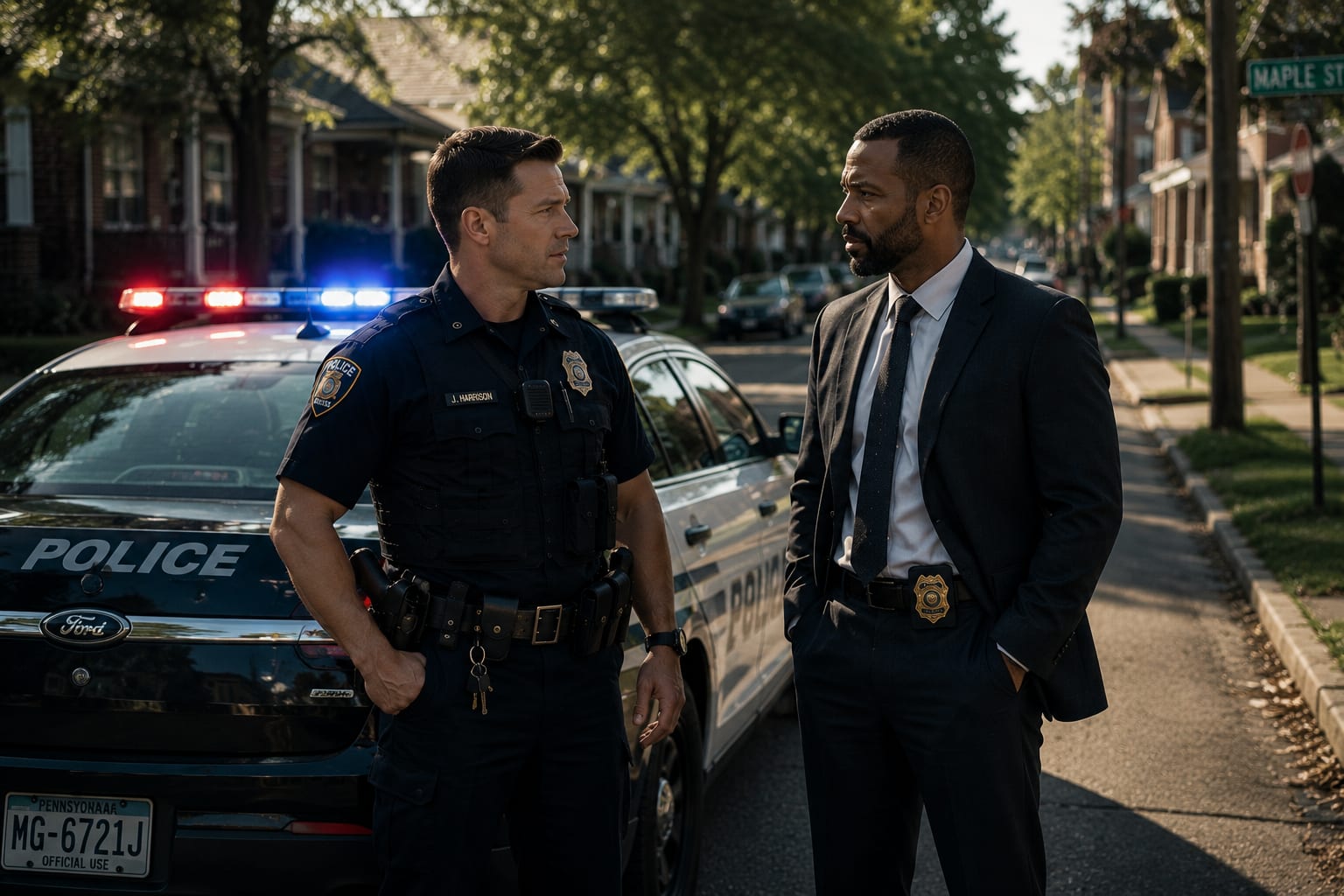
Training for those who protect and investigate
From patrol officers writing first-contact reports to major crimes investigators sitting across from a suspect, ASC delivers research-informed investigative interviewing: the rapport-based alternative to accusatorial interrogation, designed to withstand legal review and taught by a 24-year New York State Police investigator who spent more time in the interview room than the classroom. The methodology is built to improve outcomes, protect communities, and withstand legal review.
Your training is being scrutinized. Is it defensible?
Officers face unprecedented scrutiny. Every interview can be examined under a microscope, in court, in civil litigation, and in the press. Yet most agencies still rely on training that dates back decades, built on methods that research has called into question.
ASC bridges that gap. Our training draws on research in cognitive psychology, behavioral science, and forensic interviewing, delivered by a practitioner who spent 24 years doing this work, not just studying it.
Suppression rulings and false-confession civil suits often trace back to how an interview was conducted, and Franks challenges to how an affidavit was written. The wrong technique does not just lose a case; it creates exposure for your agency.
There was an overwhelmingly positive response from the Investigators and Officers in attendance, and I thought it was an extremely valuable training. We were long overdue for it here and probably an area that had been neglected for too long. It was good to get everyone on the same page, and it was interesting to watch the investigators use the techniques in real cases. I have seen them use note-taking, participatory Miranda, rapport-building, and several other techniques, and the Investigators seem to be adapting well. One of our Investigators did such a good job on a recent interview that I gathered the whole office, and we watched it as a group! Overall, I am extremely happy we went through the training as a group, and I think the two-day format was ideal for us. I think you were the right person to deliver the right message.
Lieutenant Daniel J. Belles, Colonie Police DepartmentThe record is documented. 68 court decisions on confessions, statements, and warrants, including the cases where evidence was suppressed, each broken down by the investigative issue the court ruled on. Browse the Suppression Database.
From the training room of the New York State Police Academy to yours.
This training is taught by Joseph R. Auriemma, Jr., who retired as a Senior Investigator with the New York State Police after 24 years, 17 of them in the Bureau of Criminal Investigation. He is an IADLEST National Certified Instructor, a Certified Forensic Interviewer, and the author of The Affiant's Standard, a state-by-state search warrant manual series, with the New York and Delaware editions available now. His investigative work on the Brandyn Foster homicide contributed to Google's introduction of the Tombstone Report, and his Google search warrant and preservation-letter language was adopted by the FBI's CAST unit and shared with law enforcement across the United States.
Who This Training Serves
Patrol Officers
Your first contact sets the tone for every interview that follows. ASC training gives patrol officers the field skills to build rapport quickly, gather accurate information, and document encounters accurately, without pressure tactics that create liability.
See Investigative Field InterviewingDetectives & Investigators
Whether you're working property crimes or major cases, the interview room is where investigations are won or lost. Our methods replace coercion with strategy, and produce statements that prosecutors can actually use.
See From Information to EvidenceCommand Staff & Training Coordinators
You're accountable for how your people perform under scrutiny. ASC delivers research-informed training that modernizes your agency's approach, is filed for POST credit, with approval decided by your state's credentialing body, and gives you documented, defensible methodology.
Request Agency TrainingAcademy Instructors
Build it right from day one. ASC's curriculum integrates directly with academy programs, giving new officers a foundation in ethical, effective interviewing before bad habits take hold.
Ask About Academy CurriculumSpecial Victims, Crimes Against Children & Assistant District Attorneys
The hardest interviews in the building. Disclosures from trauma-exposed victims, reluctant witnesses, and child victims rarely come in linear, complete, or first-time form. ASC trains SVU and CACU investigators, and the prosecutors who carry their cases, to conduct interviews that produce reliable testimony, protect the integrity of the case, and minimize re-traumatization. Teach to Talk is designed for adults and older teenagers. It is not a forensic interview protocol for children; when a child is the victim or witness, use the protocol your jurisdiction requires, delivered by a trained forensic interviewer, and follow all juvenile safeguards first.
See Trauma Informed InterviewingWhat Changes When Interviewing Changes
Better interviewing changes every stage of an investigation.
Research-supported rapport and recall techniques tend to produce fuller accounts, with more correct detail, from victims, witnesses, and reluctant cooperators who might shut down under pressure.
Statements obtained without coercion are built to withstand legal review, from the suppression hearing to appellate review and civil litigation.
Cases stall not only when evidence is missing but when the right questions were never asked. Trained investigators know how to uncover what people know but haven't said.
A legally sufficient warrant is the product of disciplined thinking before you walk into the affidavit, not after. ASC's search warrant training is built on the same methodology Joe used to author more than 1,500 search warrants and The Affiant's Standard, a state-by-state search warrant manual series, with the New York and Delaware editions available now. The goal is probable cause built to withstand judicial scrutiny.
Stress and trauma can impair attention and memory and can leave an account fragmented or out of order. Inconsistency is not by itself a sign of dishonesty, or of truthfulness. Officers who understand this record what the person actually remembers, test it fairly against the evidence, and avoid re-traumatizing the victim.
Our Methodology
Every course ASC delivers is grounded in Teach to Talk®, the method, and the Adaptive Strategies Compass™, its navigation framework. Teach to Talk was developed in 2016, drawing on Joe’s investigative work with the New York State Police. It is practitioner-developed and research-informed and has not been independently validated as a method. Its non-coercive, rapport-based approach is consistent with the FBI High-Value Detainee Interrogation Group’s science-informed best-practice work and the Méndez Principles (2021).
The case behind the Precision Search Warrants curriculum.
According to the FBI, the changes made during the Brandyn Foster homicide investigation positively influenced investigations throughout its national area of responsibility. Joe's investigative work on that case contributed to Google's introduction of the Tombstone Report, his Google search warrant and preservation-letter language was adopted by the FBI's CAST unit and shared with law enforcement across the United States, and he drafted the first geofence search warrant used by the New York State Police. It is the case that anchors the Precision Search Warrants curriculum and informs every page of The Affiant's Standard.
Available Training Programs
All courses are available as on-site agency training. Pricing includes materials and certificates of completion. Travel is built into open-enrollment rates and quoted at actual cost for closed deliveries.
From Information to Evidence
Non-confrontational interview techniques that turn conversations into credible evidence, built to withstand legal review. The cornerstone of the law enforcement curriculum.
Learn MoreInvestigative Field Interviewing
Equip patrol officers with skills for ethical, effective field interviews that yield reliable information and strengthen investigations from the first contact.
Learn MoreTrauma Informed Interviewing
Research-informed methods to interview trauma-exposed victims, helping them give the fullest account they can while protecting the integrity of the investigation.
Learn MorePrecision Search Warrants
Write warrants built to withstand judicial scrutiny. Taught by an investigator who authored more than 1,500 search warrants, the author of The Affiant's Standard, a state-by-state search warrant manual series, with the New York and Delaware editions available now. The course is designed for the people who have to defend their work at a suppression hearing, a Franks hearing, or on appeal.
Learn MoreThe Academy
ASC's most comprehensive law enforcement program. Five days of advanced investigative interviewing built for detectives, special investigators, and command staff.
Learn MorePolygraph Examiners
Advanced interviewing techniques tailored to polygraph examiners. Pre-test and post-test interview strategy that sharpens the examination itself and preserves a clear record of the examinee’s response, built to withstand legal review.
Learn More"Today marked my first day back on the job following your training, and I had the opportunity to implement your method during an interview with a victim. The initial statement provided by the victim to another law enforcement agency had not been effectively handled, but armed with the techniques I learned from you, I was able to facilitate a detailed narrative. Subsequently, when we located the suspect at his workplace, he was visibly agitated and confrontational. I found your approach completely disarmed him - his demeanor shifted, and he became surprisingly cooperative, ultimately making admissions to the key components of the arrest. The success of this interrogation left both myself and my partner in disbelief at how smoothly everything unfolded. Your training has undoubtedly equipped me with invaluable skills that I intend to continue honing in my work."
"On behalf of the New York State Police, I would like to thank you for participating in our 35th annual New York State Police Henry F. Williams Homicide Seminar. Your invaluable insight and expertise was greatly appreciated by this year's attendees, and your ability to convey a vast amount of information, knowledge, and experience assisted us in attaining our goal. Our attendees undoubtedly gained a great deal of valuable information and benefited from your experiences, as well as from your interesting and informative presentation."
"Thanks to Teach to Talk, I approach interviews with newfound confidence and a superior skill set. The approach is brilliantly designed to enhance communication."
Common questions from agencies
What types of law enforcement training does ASC offer?
ASC delivers a full curriculum for LE: From Information to Evidence (flagship interview methodology), The Academy (5-day advanced program), Investigative Field Interviewing (patrol-focused), Trauma Informed Interviewing, Precision Search Warrants, and Polygraph Examiner advanced techniques, all on-site at your agency.
Do ASC courses carry POST credit?
POST credit is decided by each state's credentialing body, so it varies by state. ASC applies for credit in the host agency's state upon a signed engagement. The curriculum is research-informed training built on established, research-supported methods and aligned with current professional standards. For specific POST credit confirmation in your state, contact ASC and we will provide documentation prior to scheduling.
Can ASC train an entire agency at once?
Yes. ASC training is designed for on-site agency delivery, scaling from small teams to multi-day department-wide rollouts. Larger agencies often combine multiple courses across cohorts (patrol, detectives, command staff, academy instructors), with curriculum tailored to each role.
Is training delivered on-site or in a classroom?
On-site at your agency. ASC travels to your facility to minimize officer time off-line, cut attendee travel, and deliver training in your operational context. Every course includes materials and certificates of completion; travel is built into open-enrollment rates and quoted at actual cost for closed deliveries.
Does ASC train patrol officers, or only detectives?
Both. Investigative Field Interviewing is built specifically for patrol officers, first-contact interview skills that gather accurate information and document encounters defensibly. Detectives and special victims investigators have dedicated courses tailored to their roles. Most agencies bring multiple courses across staff levels.
How does ASC differ from older, confrontational interrogation training?
The Reid Technique is commonly categorized by critics and researchers as an accusatorial interrogation model. Empirical research on accusatorial interrogation methods has found that such methods can increase the risk of false confessions, particularly when combined with coercive pressure, minimization, maximization, deception, or questioning of vulnerable suspects. Reid & Associates disputes the claim that the properly applied Reid Technique causes false confessions. ASC’s approach is the research-informed alternative: non-confrontational, rapport-based investigative interviewing built on the Teach to Talk method, which integrates the research-supported Enhanced Cognitive Interview (Fisher & Geiselman) and Strategic Use of Evidence (Granhag, Hartwig & colleagues). The approach is consistent with the FBI’s High-Value Detainee Interrogation Group (HIG) science-informed best-practice work and the Méndez Principles on Effective Interviewing (2021); the method itself has not been independently validated. With a growing number of states, beginning with Illinois and Oregon in 2021, now restricting deceptive tactics in juvenile interrogations, the direction is clear. The goal is accurate, complete information built to withstand legal review.
Does ASC training help reduce civil liability?
It can help. Coerced confession cases, Brady violations traced to interview practice, and false-statement civil suits are all major sources of agency exposure. Officers trained in non-confrontational, research-informed methods learn to take statements built to withstand legal review, to lower the risk of false confessions, and to document interview practice the agency can defend in litigation and at trial.
How do I schedule training for my agency?
Contact ASC through the Request Training form or by calling (914) 489-2330. Joe responds personally to discuss your agency’s priorities, applicable courses, scheduling, and on-site logistics. Most engagements are scoped within a single conversation and confirmed in writing.
What is the Brandyn Foster case, and how does it inform ASC training?
The Brandyn Foster homicide was a major upstate New York investigation in which Joe's investigative work contributed to Google's introduction of the Tombstone Report. From that case, Joe's Google search warrant and preservation-letter language was adopted by the FBI's CAST unit and shared with law enforcement across the United States, and he drafted the first geofence search warrant used by the New York State Police. It is the anchoring case study for the Precision Search Warrants course and informs The Affiant's Standard, a state-by-state search warrant manual series, with the New York and Delaware editions available now. ASC training carries the lessons from that case into every classroom.
10 Search Warrant Mistakes That Get Suppressed. Free.
Ten of the most common drafting errors that get warrants tossed at the suppression hearing, each with a real-world case example and the fix built to withstand challenge. Excerpted from the Precision Search Warrants course.
- Boilerplate probable cause and how to fix it
- Particularity failures that make warrants overbroad
- Stale information and how to time-anchor
- Material omissions and Franks issues
Long-form analysis from the ASC Insights library
Search Warrants That Survive Challenge
Drawn from 1,500-plus search warrants. Affidavit structure, common suppression vulnerabilities, and digital-evidence considerations.
Read → Trauma-InformedHow to Interview a Trauma-Exposed Victim Without Re-Traumatizing Them
How stress can affect attention and memory, environmental setup, language choices, and documentation built to withstand review at trial.
Read →Ready to give your team training built to withstand legal review?
On-site training available for agencies of all sizes. Joe responds personally. Let's talk about what your team needs.