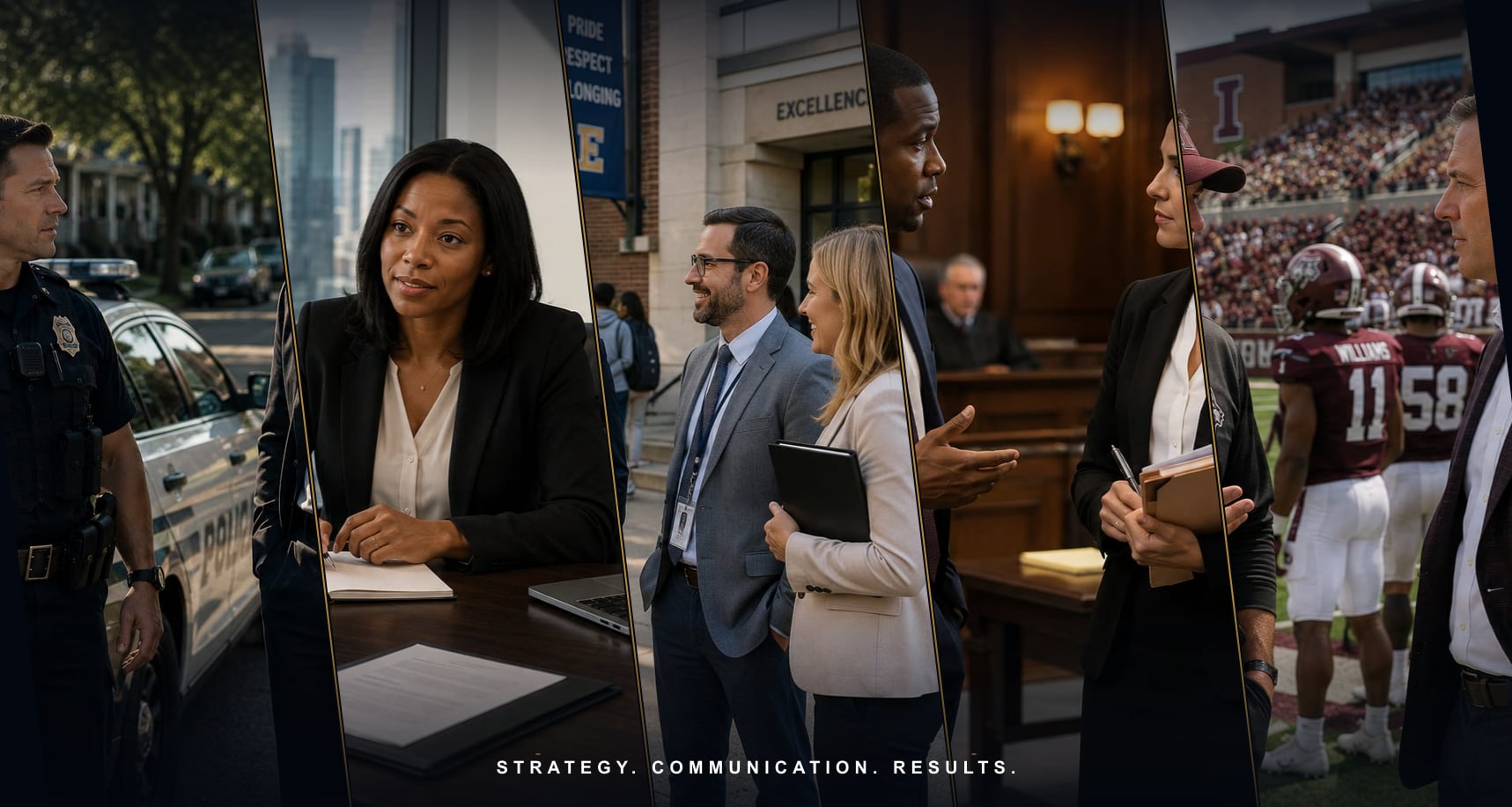
Who We Serve
Five sectors. One discipline. The mechanics of asking the right question, listening for what matters, and turning conversation into reliable information are the same whether you are investigating a homicide, conducting an HR matter, deposing a witness, interviewing a student, or evaluating a recruit. Teach To Talk® is the method that holds it all together, and the Adaptive Strategies Compass™ is the navigation tool inside it: when an interview starts to struggle, it tells you which way to turn. That is why ASC can serve law enforcement, private sector, education, legal, and sports with the same underlying method.
In every sector, the failure is the same: the interview that does not hold up.
What makes one method work across five sectors?
The surface of an interview changes from sector to sector, but the underlying mechanics do not. A homicide detective, an HR investigator, a defense attorney, a school administrator, and a scout are all doing the same fundamental work: establishing rapport, gathering information, testing what they are told, and producing a record that has to hold up under scrutiny.
Every interviewer eventually hits the moment when the conversation stalls: answers shrink, rapport slips, a topic goes quiet, or the account collides with the evidence. The usual instinct is to push harder. The Adaptive Strategies Compass asks why first. Eight directions, no fixed order, one for each reason an interview struggles, point the interviewer to the move that fits. It is one framework for victims, witnesses, and suspects, because it reads the condition, not the role.
Navigate the condition, not the role. Role changes the safeguards, not the standard.
What failure looks like in your sector

Law Enforcement and Public Safety
Suppression motions, civil suits, and lost cases trace back to interviews that were never going to hold up. ASC courses teach officers, investigators, detectives, and academy cadets to conduct interviews that produce reliable information, built to withstand legal review.

Private Sector and HR
An internal investigation that misses the truth, or finds it but cannot document it, costs an organization more than the underlying incident. ASC courses teach HR professionals, compliance officers, and internal investigators to conduct workplace interviews that lead to well-documented findings, built to withstand legal challenge.

Educational Institutions
Campus investigations under Title IX, code of conduct, or HR jurisdiction face challenge at every step. ASC courses teach administrators, Title IX coordinators, deans of students, and school resource teams to conduct unbiased, compliant investigations that protect students, staff, and due process.

Attorneys
What a witness says under oath is shaped by what happens before the deposition starts. ASC courses teach litigators, prosecutors, defense counsel, and legal investigators client intake, witness preparation, and deposition strategy that protects the record.

Sports Organizations
What you hear in a scouting interview, an internal investigation, or a sit-down with a player can carry consequences worth millions. ASC courses teach coaching staff, scouts, and team leadership to get past rehearsed answers to specific, checkable detail, and to reach findings built to hold up under scrutiny.
Courses that work across sectors.
The flagship course and the method behind it rest on the same fundamentals in every sector. The audience changes. The fundamentals do not.
From Information to Evidence
Originally built for law enforcement, the foundational principles taught here scale into every investigative discipline. The cornerstone of the ASC curriculum.
Learn MoreOur Methodology
The full architecture of how ASC trains. Read how Teach To Talk and the Adaptive Strategies Compass work together across every sector we serve.
Learn MoreThere was an overwhelmingly positive response from the Investigators and Officers in attendance, and I thought it was an extremely valuable training. We were long overdue for it here and probably an area that had been neglected for too long. It was good to get everyone on the same page, and it was interesting to watch the investigators use the techniques in real cases. I have seen them use note-taking, participatory Miranda, rapport-building, and several other techniques, and the Investigators seem to be adapting well. One of our Investigators did such a good job on a recent interview that I gathered the whole office, and we watched it as a group! Overall, I am extremely happy we went through the training as a group, and I think the two-day format was ideal for us. I think you were the right person to deliver the right message.
Lieutenant Daniel J. Belles, Colonie Police DepartmentStill deciding which sector fits your team?
Let's figure it out together.
Schedule a free strategy call. Joe will recommend the right training based on your team's role, size, and operational pressures. No obligation, no pitch, just a working conversation about what your people actually need.