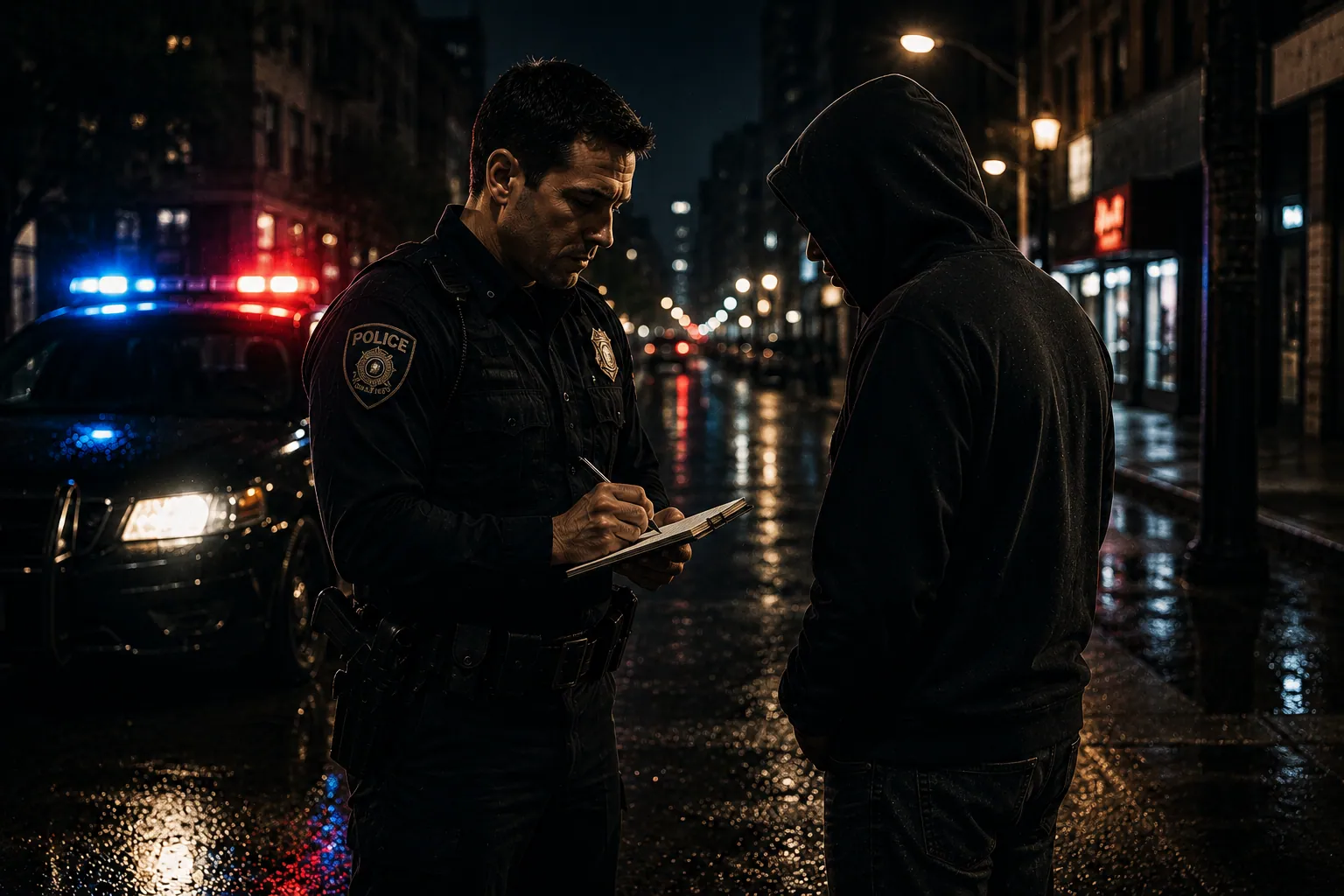
Patrol Officer Training
The patrol-officer deployment of the Teach to Talk® philosophy and the Adaptive Strategies Compass™. Built for the conditions where most investigations actually begin, the curb, the doorstep, the scene, the front seat of a cruiser.
Patrol officers make more investigative decisions in one shift than most investigators make in a week. This course teaches them to gather information strategically, assess behavior in real time, and control field contacts without escalating them unnecessarily.
Observe. Assess. Adapt.
Communication is the first tactic.
Advanced communication·Real-time intelligence·Built for uncontrolled environments
They were taught commands. They were taught officer safety. They were taught legal thresholds. They were taught control tactics.
Very few were taught how to strategically gather information, how to lower resistance, how to assess credibility, or how to manage conversation under stress.
So officers default to rapid-fire questioning, premature accusations, unnecessary escalation, or missed opportunities, and the case starts losing ground before the first follow-up.
The first conversation often determines everything that follows.


Officers will learn how to:
Control the pace and direction of field encounters
Build rapid rapport without sacrificing officer presence
Identify behavioral changes tied to stress, concealment, and cognitive load
Transition from enforcement mode to information-gathering mode
Recognize when a contact is becoming resistant, deceptive, or threat-focused
Use strategic conversation to increase voluntary disclosure
Gather usable intelligence while maintaining tactical awareness
Conduct interviews that support later investigative and prosecutorial efforts
"The techniques in this course were not developed for a training room. They were developed in the field, in the conditions patrol officers actually work in."
Joseph R. Auriemma, Jr.This is not interview training for patrol.
It is advanced communication and intelligence acquisition for first responders operating in uncontrolled environments.
These are the environments where most patrol contacts begin and where most investigative information is gained or lost in the first conversation.
This is not classroom theory.
Detectives may have an hour. Patrol officers have minutes, sometimes seconds. The Adaptive Strategies Compass™ does not change in the field, it compresses. Every direction of the framework deploys at patrol speed, in the conditions you actually work in.
The foundational philosophy, deployed at the doorstep, the roadside, the scene. Strategic, human-centered conversation that lowers defenses and produces voluntary disclosure in the first contact.
A six-stage investigative thinking framework (Assess, Collect, Collate, Evaluate, Survey, Summarize). On patrol, Assess and Collect happen on every call. The remaining stages link the field contact to everything that follows.
Behavioral style read in seconds, not minutes. Knowing how a subject communicates before you decide how to communicate with them is the single highest-leverage skill in a short contact.
The most research-validated technique for improving recall accuracy, adapted for the speed of patrol. Context reinstatement and varied retrieval deployed in the first ten minutes, when victim and witness memory is most accurate and least contaminated.
Conversation planning at patrol speed. Anticipating where the contact is likely to branch before you step out of the car, and keeping strategic direction when the encounter turns.
Understanding why a person is behaving the way they are right now. Five lenses (Rationalize, Project, Minimize, Socialize, Emphasize the Truth) compressed into the live read of a field contact.
At first contact, what you do not reveal matters as much as what you ask. Testing the consistency of accounts without prematurely showing what you already know.
Challenge-and-clarify questioning that surfaces contradictions without losing scene control. Disciplined intervention when accounts shift, evade, or shut down.
Every direction in this Compass deploys in the field. Patrol officers leave this course with the complete framework, calibrated for the speed and pressure of first contact.
Explore the Adaptive Strategies Compass™ →Constitutional requirements, voluntary contact vs. detention vs. arrest, admissibility standards, and the boundaries that determine whether anything obtained in the field can be used in court. Every technique taught after this is built within those legal bounds.
The cognitive framework for organizing information at the scene and making disciplined decisions about how evidence is developed, tested, and used. Officers leave with a way to think about cases, not just techniques to apply to them.
How memory works in the field, what officer behaviors contaminate information at the scene, and the conditions that consistently produce accurate disclosure under time pressure. Everything else in the course is built on this foundation.
Rapport is the single most reliable predictor of interview quality, even in time-constrained patrol contacts. The Teach to Talk® methodology moves field interviews away from rapid-fire questioning and toward adaptive, strategically directed conversations that produce voluntary disclosure.
A documentation discipline that captures critical detail without breaking the interview thread, rapport, or disclosure flow. Field notes that translate cleanly into accurate, court-defensible written statements.
Rapid identification of behavioral tendencies and the establishment of reliable individual baselines, even in short field contacts. Without a baseline, no behavior is “deviant”, and every behavioral judgment built on a missing baseline is unreliable.
Observing the verbal, behavioral, and physiological deviations that signal where deeper inquiry is needed during a field contact. What changes mean, what they don’t mean, and how to follow them without leading the subject.
Changes in posture, tone, pace, eye contact, movement, and emotional regulation, used as context for stress, rapport, resistance, comfort, and engagement, never as standalone deception cues. Grounded in research on what nonverbal signals can and cannot tell us about a conversation.
Victims in the field are often in acute distress. Trauma-informed technique, managing emotional dysregulation at the scene, and supporting complete disclosure without re-traumatization, because contaminated victim accounts in those first minutes rarely get repaired later.
On-scene witnesses are the most time-sensitive evidence source on any investigation. Memory contamination mechanisms, the role of suggestion and post-event information, and techniques that capture accurate accounts before memory degrades or outside influence takes hold.
Approach strategy, baseline establishment, managing denial and minimization, recognizing resistance and evasion patterns, and moving a resistant subject toward disclosure during a field contact. All within a framework that is legally sound, ethically grounded, and tactically effective.
The most research-validated technique for improving recall accuracy, adapted for the constraints and speed of patrol contacts. Context reinstatement, varied retrieval, and other ECI elements deployed across victim, witness, and applicable suspect interviews in the field.
How and when evidence is revealed during a field contact is as tactically important as the evidence itself. Testing the consistency of accounts, surfacing inconsistencies, and creating conditions for disclosure without prematurely revealing what you know.
Moving from field notes to a written statement that is accurate, complete, and legally defensible when the case goes forward. Patrol-generated statements are frequently the foundation of the entire investigation, they need to be done right the first time.
The course is delivered as a one-day intensive on-site at your agency. The single-day format covers the complete framework, legal foundations, rapid personality assessment, rapport-building, victim engagement, witness interviewing, suspect strategies, and written statements, calibrated for the pace and constraints of patrol work.
Patrol officers (rookies building foundations and veterans who want structure to match their instincts), Field Training Officers who develop technique in new officers, and supervisors who need to recognize what effective patrol-level interviewing looks like. The course is also valuable for any officer whose first contact often becomes the first interview in an investigation.
By the time a detective arrives, the patrol officer has already spoken to the victim, the witness, and possibly the suspect. The quality of those first conversations shapes what leads get pursued, what evidence gets preserved, and whether any of it survives a suppression hearing six months later. Most LE training treats interviewing as a detective skill, it isn’t.
Field-specific application, not interview-room theory. Working across roadside, residential, commercial, medical, and public settings; maintaining situational awareness during interviews; rapid personality assessment under time pressure; recognizing trauma in distressed victims at the scene; and capturing written statements that hold up when the case advances. Real-world patrol contexts, not classroom scenarios.
Yes. The Legal Basics module covers constitutional requirements, voluntary contact vs. detention vs. arrest, admissibility standards, and the boundaries that determine whether what officers learn in the field can be used in court. This is foundational, every interview technique taught after that is built within those legal bounds.
Victims in the field are often in acute distress. The course teaches deliberate, empathetic approaches grounded in trauma-informed practice, recognizing how trauma affects disclosure, memory, and cooperation, and building the trust that determines what information surfaces in those critical early stages. Contaminated or incomplete victim accounts at the scene rarely get repaired later.
Yes. The Focus Note-Taking Method captures critical detail without breaking the interview thread, and the course covers how to move from field notes to a written statement that is accurate, complete, and legally defensible when the case goes forward. Patrol-generated statements are frequently the foundation of the entire investigation, they need to be done right the first time.
The course is delivered on-site at your agency in a one-day format. Contact ASC through the Request Training form or by calling (914) 489-2330 to discuss scheduling and squad/shift logistics. Joe responds personally to scope the engagement.

Joseph R. Auriemma, Jr. served 24 years with the New York State Police, including 6.5 years in the Major Crimes Unit. He retired as a Senior Investigator supervising 5 investigators and 29 uniformed troopers. His career spanned thousands of interviews across the full spectrum, homicide, major narcotics, multi-jurisdictional cases, and every subject type from cooperative witnesses to seasoned criminal subjects.
Through FBI-facilitated coordination on a major homicide investigation, Joe engaged engineering personnel at Google about deleted-user-data records that existed in Google systems but were not being produced in response to lawful process. Those findings directly contributed to the development of what became known as the Google Tombstone Report, an internal Google record now relied on by law enforcement worldwide. That same investigative discipline is the foundation of every course he teaches.
Certifications: IADLEST National Certified Instructor (INCI) · Certified Forensic Interviewer (CFI) · Certified Polygraph Examiner
The first conversation shapes every conversation after it. Strong patrol-level interviewing produces better leads, better witnesses, better statements, and cases that hold up. Weak patrol-level interviewing forces every investigator who follows to work uphill.
Contact ASC to schedule training customized to your patrol environment and the calls your officers actually run.
One-day format. Scenario-based. Built for the environments your officers actually work in.