Home/About/Books/The Affiant’s Standard/Delaware
The Wilmington, Delaware riverfront skyline at night, reflected on the Christina River
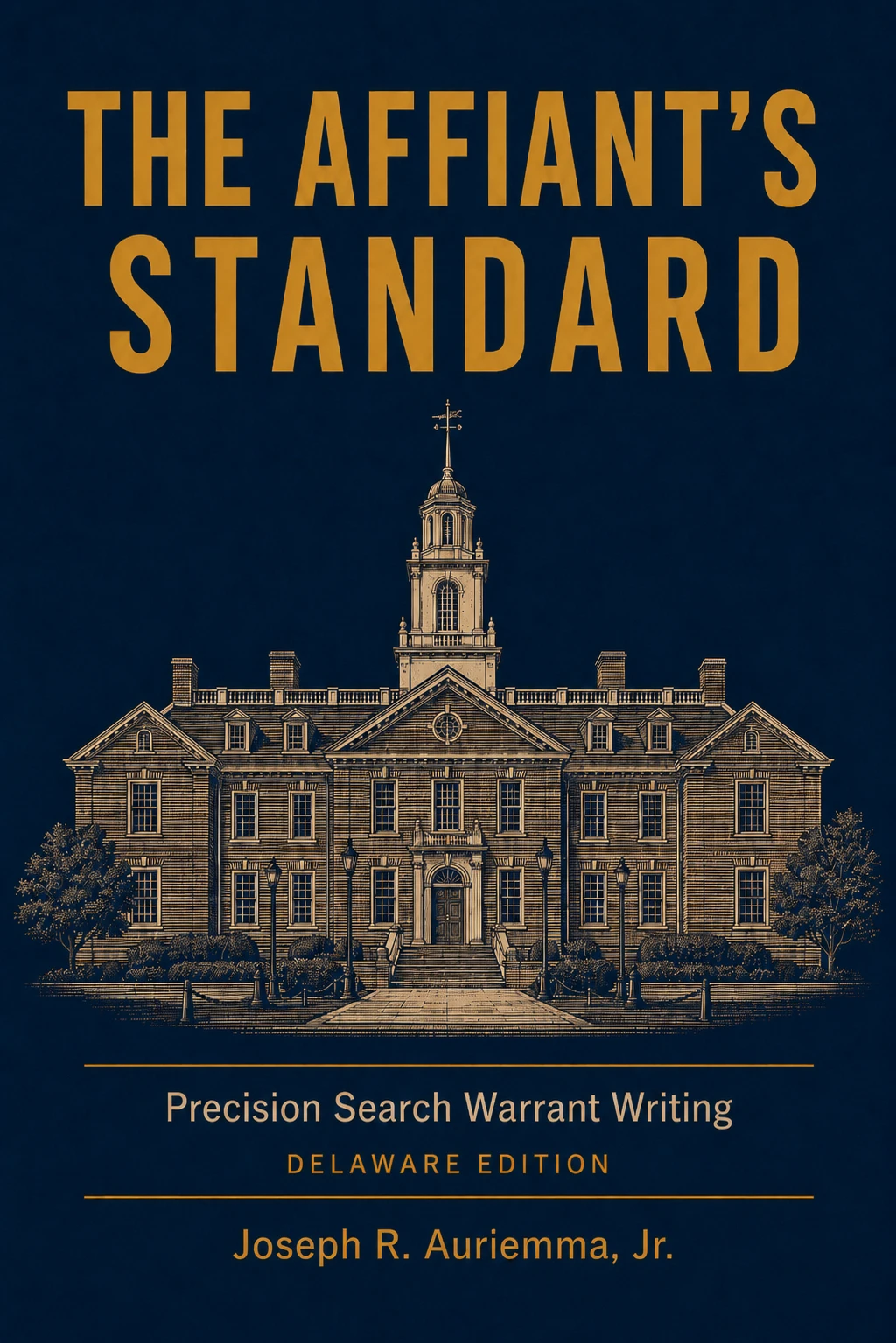
The Affiant’s Standard

Delaware Edition · Available Now

Built for Delaware. Written to survive.

The Affiant’s Standard: Delaware Edition is a two-volume system for the Delaware affiant. A comprehensive manual walks Title 11, Chapter 23 and the full arc of drafting, execution, and suppression doctrine, section by section, alongside a Search & Seizure Companion covering the federal Fourth Amendment and Delaware’s Article I, § 6 protections. Written from the affiant’s chair by Joseph R. Auriemma, Jr., across 24 years and more than 1,500 search warrants with the New York State Police. Not fill-in-the-blank templates, doctrine.

Not templates. 40 drafted examples. Doctrine throughout.

Title 11, Chapter 23, section by section·40 drafted examples·113 Practice Notes
Series
The Affiant’s Standard
Edition
Delaware (available now)
Format
Paperback
ISBN
979-8-9952462-4-4
Author
Joseph R. Auriemma, Jr.
Order the Books
40
Drafted Examples
1,500+
Search Warrants Authored
7
Substantive Parts
$115
Delaware Edition Price
The Affiant’s Standard: Delaware Edition, by Joseph R. Auriemma, Jr.
$115
Paperback

Printed on demand. Allow 3 to 5 business days for printing, plus shipping. Returns & refunds

The Delaware Edition of The Affiant's Standard
Delaware Edition · Available Now

The Affiant’s Standard

By Joseph R. Auriemma, Jr. · Affiant on 1,500+ Search Warrants · 24 Years NYSP

A comprehensive, practice-driven guide for law enforcement professionals responsible for developing probable cause, drafting affidavits, and navigating judicial review. Written by a retired New York State Police Senior Investigator who served as the affiant on more than 1,500 search warrants, this manual goes beyond mechanics and templates to focus on disciplined thinking, precise articulation, and risk management for suppression.

It is grounded in real investigations, real judicial scrutiny, and real suppression litigation, not theory. This manual is designed to help investigators understand how courts actually read affidavits, why suppression occurs predictably, and how clear, fact-driven articulation protects strong cases.

Stand-Alone Reference

A practical field reference for any investigator who drafts warrants, from first warrant to your thousandth.

Course Companion

Designed to complement ASC’s Precision Search Warrants training, reinforcing and extending what’s taught in the classroom.

“Rather than providing fill-in-the-blank templates, the manual teaches a structured framework for thinking, writing, and self-auditing warrant applications so they withstand judicial and appellate review.”

View Search Warrant Course
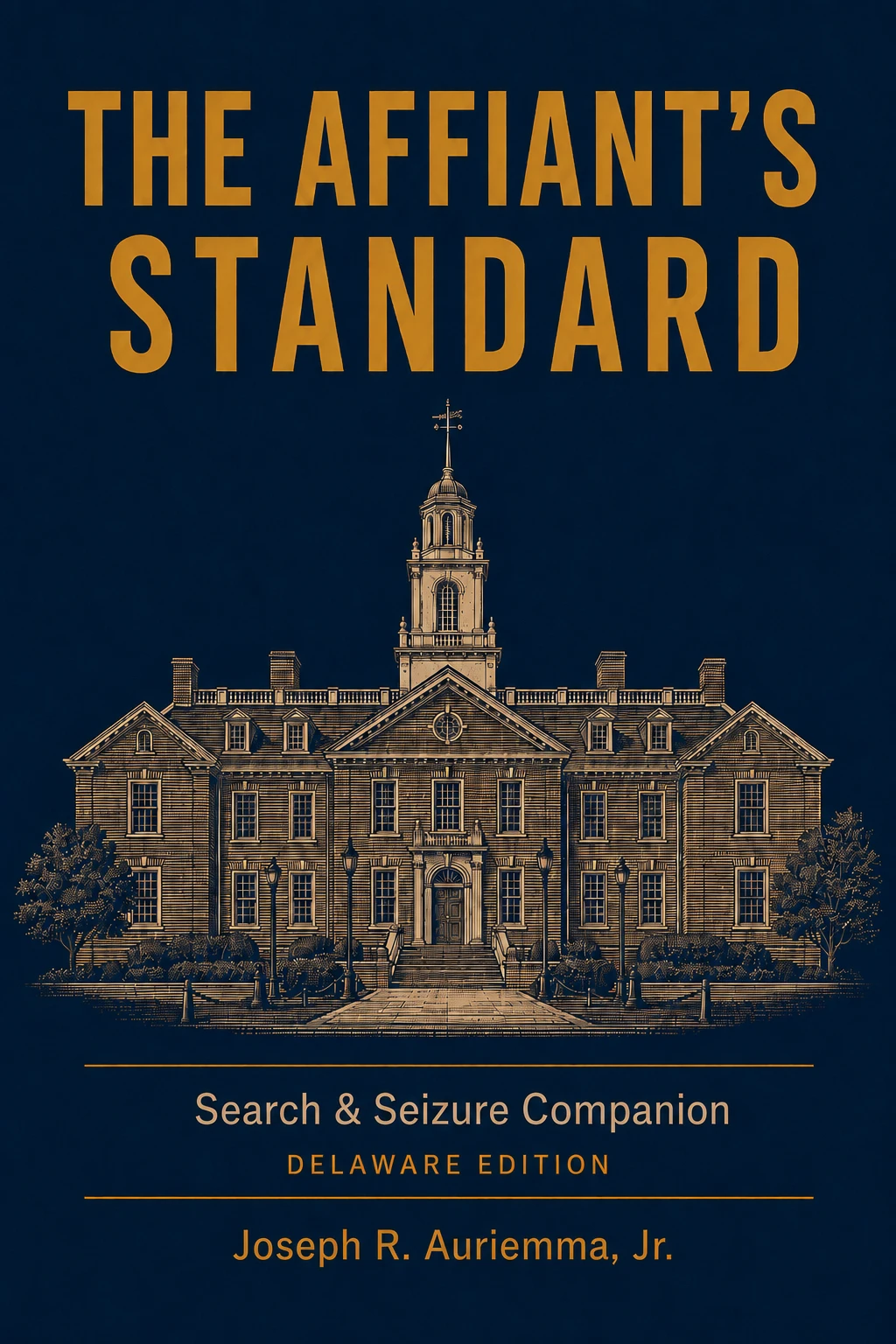
The Affiant’s Standard: Delaware Search & Seizure Companion, by Joseph R. Auriemma, Jr.
$59
Paperback

Printed on demand. Allow 3 to 5 business days for printing, plus shipping. Returns & refunds

Companion Volume to the 50-State Series
Delaware Edition · Available Now

The Affiant’s Standard: Delaware Search & Seizure Companion

By Joseph R. Auriemma, Jr. · The Constitutional Foundations Volume

The manual’s companion volume covers the constitutional foundations in depth: the complete federal Fourth Amendment framework (Katz, Gates, Carpenter, Riley, Jones, and every controlling precedent) and Delaware’s Article I, § 6 protections, along with the law governing warrantless searches, street encounters, frisks, consent, inventories, and related authorities.

Together, the manual and the Companion form a complete search warrant and search-and-seizure training system for Delaware law enforcement.

View Search Warrant Course
The Complete Set

The manual and the Companion, together

Order The Affiant’s Standard and the Delaware Search & Seizure Companion at the same time and get the complete drafting-and-constitutional system in one purchase.

$149 for both books · $174 bought separately Save $25

Printed on demand. Allow 3 to 5 business days for printing, plus shipping. Returns & refunds

The Series

The series. Edition by edition.

Search warrant doctrine is state-specific. Federal Fourth Amendment law sets the floor, but each state’s statutes, case law, and judicial culture shape how affidavits actually get read and ruled on. The Affiant’s Standard is built that way too: a separate edition for each jurisdiction, each one written from the inside, each one teaching the same disciplined framework calibrated for local practice.

New York Edition · Available Now

New York Edition

Shipping Now

The flagship edition, written from the affiant’s chair across 24 years of New York State Police investigative work.

Delaware Edition · Available Now

Delaware Edition

Shipping Now

The Delaware Edition, calibrated to Title 11, Chapter 23 and the decisions of the Delaware Supreme Court, written in the same disciplined framework as the flagship.

Next Editions · In Production

Additional State Editions

Multi-year publishing arc

More state editions are in production on the way to a complete 50-state library, each one tailored to its jurisdiction’s statutes, case law, and judicial practice.

Already own the Delaware Edition? When the law changes after a print run, ASC publishes free manual update memos for current owners.

Inside the Delaware Edition

Inside the Delaware Edition. Seven parts. One discipline.

The Delaware Edition is structured around seven substantive parts, framed by a preface that establishes professional responsibility for the affiant and closed by a working reference apparatus: a glossary, a table of cases, a table of statutes and rules, and a full topical index. It is the drafting and execution volume, covering the full text and operation of Title 11, Chapter 23, probable cause development, affidavit drafting from statutory introduction to nexus paragraph, suppression doctrine with Delaware case studies, warrant execution standards, specialized topics in digital and emerging evidence practice, and seventeen advanced decision-making outlines. It pairs with The Affiant’s Standard: Delaware Search & Seizure Companion, which covers the federal and Delaware constitutional foundations in depth.

The Delaware Edition contains 40 drafted examples, plus warrants, item lists, operations plans, returns, and defense motions distributed across the manual, and 113 Practice Notes. Each example is calibrated to a specific case type and doctrinal moment, with a Practice Note explaining why the example is constructed the way it is.

  • The core principle and what probable cause actually requires
  • Where affiants go wrong, and why digital evidence does not lower the bar
  • Warrant writing philosophy: judges are not adversaries, credibility is cumulative, articulation is evidence, restraint is persuasive, candor protects more than cleverness
  • How to use the manual, the Foundations for Warrant Writing chapter, and what the manual does not do
  • Court structure and jurisdiction in the Delaware courts, and why it matters for warrant applications
  • 11 Del. C. §§ 2301, 2305, 2306, and 2310: search warrants in general, property subject to seizure, and what and who are subject to search
  • 11 Del. C. §§ 2304, 2307(a), 2308, and 2310: where warrants are executable, to whom addressable and by whom executable, and when a warrant may be executed, including nighttime execution
  • 11 Del. C. § 2306 and § 222(24): the search warrant application, and remote oath and electronic applications
  • 11 Del. C. §§ 2307, 2309, 2310, and 2311: determination of the application, form and content of the warrant, execution, and disposition of seized property
  • Sources of probable cause: personal observation, training and experience, victims and eyewitnesses, citizen informants, confidential and anonymous informants and the corroboration requirement, fellow officers, admissions, and physical, forensic, electronic, and digital evidence
  • Manner of acquisition of proof, hearsay, and incorporation by reference
  • Staleness and the maintenance of current probable cause
  • Nexus requirements for residences, vehicles, and digital devices
  • Particularity, overbreadth, and severability, including multi-unit structure description and anticipatory warrants
  • Controlled buy documentation
  • The general structure of the affidavit, affiant background and qualifications, and identifying the crime
  • Place-to-be-searched description standards, multi-unit structure drafting, and the limited-purpose paragraph
  • The factual narrative: source attribution, separating facts from inferences, chronology and dating, addressing gaps, and writing in a neutral tone for the judge
  • The evidence-sought item list, with category-specific guidance, and the dedicated nexus paragraph, including digital nexus standards under Delaware law
  • Secondary requests: nighttime execution, unannounced entry, biometric device unlocking, and sealing of the warrant and supporting affidavit
  • Signature requirements and oath, common affidavit defects that lead to suppression, affiant tone and credibility, and prosecutor collaboration with the Department of Justice
  • Suppression as a predictable synthesis of doctrine and practice, and the seven recurring suppression patterns
  • The severability doctrine and standing to suppress
  • Delaware case studies on search warrant suppression
  • Franks hearings: challenging the truthfulness of the affidavit
  • The affirmative case for getting a warrant, reading your own affidavit as a defense attorney would, and testifying about the affidavit
  • Pre-execution operations planning, execution standards, and body-worn cameras during warrant execution
  • Knock-and-announce, Hudson and the Delaware approach to knock-and-announce remedies, and the unannounced-entry case-specific exception
  • Nighttime warrants under 11 Del. C. § 2308 and the execution windows under 11 Del. C. § 2310(b), (c)
  • Securing the scene under the McArthur rule, closed containers, plain view, and plain view of cannabis during execution
  • Detaining and searching persons present; children, vulnerable persons, and animals during execution
  • Amending and additional warrants during execution, the mid-execution return to the magistrate, post-execution return, inventory, and discovery, and multi-agency and joint task-force executions
  • Cell phones under the Riley rule, cell site location information under the Carpenter rule, and the Stored Communications Act framework under 18 U.S.C. §§ 2701–2713
  • Biometric device unlocking, and GPS trackers under Holden and Article I, § 6
  • Searching parolees and probationers under the Delaware regime, use of drones in investigations, and geofence warrants
  • DNA evidence: warrants, consent, and the statutory database under 29 Del. C. § 4713
  • Subpoenas versus search warrants, pen registers and trap-and-trace devices, and wiretap and electronic surveillance orders under 11 Del. C. §§ 2401–2412
  • Emerging areas in digital warrant practice
  • Affiant credibility and risk management, suppression pattern recognition, and probable cause narrative construction
  • The affidavit requirements outline under 11 Del. C. ch. 23
  • Articulation outlines for citizen informants, confidential informants, the anonymous informant (★), controlled buys, and consent searches
  • Nexus development and location justification across all evidence categories
  • Announced entry and the unannounced-entry exception (★), detaining and searching people during execution (★), and digital evidence preservation and pre-warrant handling
  • Judicial interaction and revision strategy, and warrant amendment versus new warrant decision-making
  • The affiant across time: judicial relationship management, and constructing the affiant biography
  • Red-flag phrases and their disciplined replacements
  • Federal search warrant practice as a comparative framework for officers
  • The digital search protocol for smartphones, computers, and cloud accounts and online services
  • A federal versus Delaware law divergence reference
  • A sample warrant return form, and a tour of the common defense motions an affiant will face
  • How courts read affidavits (the judicial mental model), the common judicial questions during warrant review, and a pre-submission judicial self-audit checklist
  • Topical references for Franks risk and candor, scope control, affidavit paragraph construction, and staleness and freshness, plus case law by offense type
  • The glossary, table of cases, table of statutes and rules, and topical index
The Next Editions

Be the first to know when your state ships.

The New York and Delaware Editions and their Search & Seizure Companions are available now. Additional state editions are in active development. Join the list to hear which state is up next, when each edition enters production, and when it ships.

Agency & Academy Orders

Equipping a unit, not just a desk.

The Delaware Edition is built for individual investigators and the units that draft warrants together. Agency and academy orders qualify for bulk pricing, custom invoicing, and direct shipment. Whether you’re outfitting a homicide squad, a digital crimes unit, a regional task force, or a basic investigator training academy, ASC will work with your procurement team directly.

Bulk Pricing

Volume discounts available for orders of 10 or more. Pricing tiers scale with quantity.

Agency Invoicing

ASC handles purchase orders, W-9 documentation, and net-30 invoicing for qualified agency procurement.

Direct Shipment

Books ship directly from ASC to your agency, academy, or training facility. Custom packaging available for academy adoption.

Request Agency Pricing

Joseph R. Auriemma, Jr.
About the Author

Written by someone who lived the work

Joseph R. Auriemma, Jr. spent 24 years with the New York State Police, including 6.5 years as a Senior Investigator in the Major Crimes Unit. He served as the affiant on more than 1,500 search warrants across his career, covering homicide investigations, financial crimes, narcotics cases, child sexual abuse, and the full breadth of digital evidence. His investigative work on the Brandyn Foster homicide contributed to Google’s introduction of the Tombstone Report and reshaped how investigators across the country draft warrants for digital and cloud-stored evidence.

He was Lead Instructor at the New York State Police Academy for Basic Search Warrants and Advanced Search Warrants. The Affiant’s Standard is the book he would have wanted on his desk when he wrote his first warrant.

It is the book he wrote so the next investigator wouldn’t have to learn it the hard way.

Read Joe’s Full Bio ›

1,500+
Warrants Authored
24 Yrs
NYSP Experience
17 Yrs
Bureau of Criminal Investigation

Three ways to engage.

Order the manual and the Companion, request agency pricing for a unit-wide adoption, or pair the books with the live Precision Search Warrants course that puts their framework into practice.